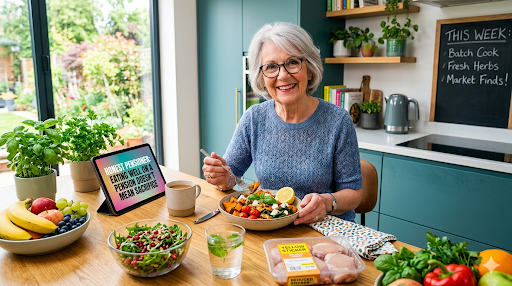
Eating well on a pension is one of the most searched topics among UK retirees right now — and for good reason.
Why this guide matters more than ever right now: A global fertiliser crisis triggered by the closure of the Strait of Hormuz could push UK food prices noticeably higher by late 2026. We’re not predicting doom — but it’s a genuine risk that makes every tip in this guide more valuable right now. Read our companion article for the full explanation.
Here’s a statistic that might surprise you. According to the Office for National Statistics [ONS Family Spending Survey], food and non-alcoholic drinks already account for around 11% of total household spending for retirees. That’s a significant chunk of a fixed income — and it’s rising fast.
If you’re retired, or approaching retirement on a limited pension, you’ll know the pressure of making every pound count. But here’s the good news: eating well on a pension doesn’t have to mean tins of baked beans and soggy rice. With the right approach, you can eat healthily, enjoy your food, and still have money left over. Eating well on a pension is exactly what this guide is designed to help you do.
This guide is packed with practical, real-world advice for UK retirees who want to stretch their pension further without sacrificing nutrition or pleasure. No gimmicks. No unrealistic meal plans. Just honest, sensible tips that actually work.
Why Eating Well on a Pension Is Harder Than It Looks
Let’s be honest. Food prices in the UK have been brutal over the past few years. The Consumer Prices Index [ONS Inflation Data] showed food inflation peaking at over 19% in early 2023 — the highest in 45 years. For someone on a fixed State Pension, that kind of increase doesn’t just sting. It fundamentally changes what you can afford to put on your plate.
There are a few reasons it’s particularly challenging for retirees:
- You’re often cooking for one or two, making bulk cooking less obvious.
- Supermarkets tend to price “value” packs at sizes that don’t suit smaller households.
- Mobility or health issues can limit where and how often you shop.
- Fixed pension income doesn’t flex when prices do.
Despite these challenges, eating well on a pension is absolutely achievable with the right approach.
But here’s the thing — millions of UK pensioners are quietly cracking this problem every day. And most of them will tell you it comes down to planning, knowledge, and a few well-chosen habits.
Plan Your Meals — It’s the Single Biggest Money-Saver
If there’s one tip you take from this entire article, make it this: plan your meals before you shop. Not because it’s fussy or time-consuming — because it saves a genuine amount of money. It’s the foundation of eating well on a pension without watching every single penny.
Studies from WRAP (Waste & Resources Action Programme) [Love Food Hate Waste] consistently show that UK households throw away around £700 worth of food every year. For pensioners, that figure is smaller — but every wasted pound hurts more.
How to build a simple weekly meal plan
- Check what’s already in your fridge, freezer and cupboards first.
- Plan 5–6 meals for the week — not every single one, just the main ones.
- Build your shopping list from that plan, not the other way around.
- Look at what’s on offer that week — and adjust the plan if there’s a deal worth having.
- Cook once, eat twice: soups, stews and casseroles reheat beautifully.
Think of it like this: a meal plan is just a shopping list with a bit of foresight. It takes ten minutes on a Sunday morning, and it’ll save you far more than that in wasted food and impulse buys.
Where to Shop — and What the Supermarkets Don’t Want You to Know
Brand loyalty can be expensive. The UK supermarket landscape has changed dramatically, and sticking with one shop out of habit could be costing you significantly more than you need to spend. Knowing where to shop is just as important as knowing what to buy when you’re eating well on a pension.
Aldi and Lidl: no longer just for the young
The discount supermarkets have improved enormously. Which? [Which? Supermarket Comparison] regularly finds Aldi and Lidl to be 20–30% cheaper on a typical basket than the major chains. Their own-brand products are often made by the same manufacturers as premium brands — just without the fancy packaging.
Other money-saving shopping strategies
- Shop later in the day for yellow-sticker reductions on fresh produce and meat.
- Use the supermarket’s own-brand range for staples — pasta, rice, tinned tomatoes, oats.
- Buy frozen vegetables rather than fresh — equally nutritious, far cheaper, and no waste.
- Use price comparison apps like Trolley.co.uk to check who’s cheapest for your regular items.
- Consider online grocery shopping to remove impulse purchases from the equation.
One practical tip worth mentioning: the NHS Healthy Start scheme and local food banks [Trussell Trust Food Bank Finder] are available if you’re in genuine need. There’s no shame in using services that exist precisely for this purpose.
What to Actually Eat: Budget-Friendly Foods That Are Good for You
The good news is that some of the healthiest foods for older adults are also among the cheapest. This isn’t a coincidence — whole foods, unprocessed ingredients, and simple staples have always been the backbone of good nutrition.
The secret to eating well on a pension is building your meals around these affordable, nutritious staples.
The pensioner’s power pantry
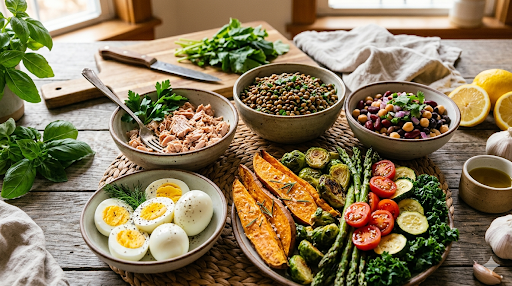
- Eggs — affordable, protein-rich, and endlessly versatile. Scrambled, poached, boiled, or in a frittata.
- Tinned fish (sardines, mackerel, tuna) — excellent source of omega-3, and typically under £1 a tin.
- Lentils and beans — fill you up, support heart health, and cost pennies per portion.
- Porridge oats — a proper breakfast for about 10p per serving. Add a banana for potassium.
- Seasonal vegetables — cabbage, carrots, swede, and onions are cheap year-round and nutritious.
- Frozen peas — arguably the best value vegetable in the freezer aisle.
- Sweet potatoes — nutrient-dense, filling, and usually cheaper than regular potatoes per serving.
The British Nutrition Foundation [BNF Nutrition for Older Adults] notes that older adults particularly benefit from higher protein intake, calcium-rich foods, and vitamin D. Most of these don’t require expensive supplements — just a little thought about what goes on the plate.
Cook Smarter, Not Harder: Batch Cooking and Freezing
Here’s a quiet secret that many retired couples and solo pensioners swear by: cook big batches and freeze individual portions. It’s not just about saving money — it means you always have something decent to eat on days when energy or motivation is low.
Batch cooking is one of the most underrated strategies for eating well on a pension.
Meals that batch-cook brilliantly
- Soups — a large pot costs £2–3 to make and provides 6–8 portions.
- Chilli con carne or veggie chilli — freezes perfectly, quick to reheat.
- Cottage pie or shepherd’s pie — comforting, filling, and cheap with minced beef or lentils.
- Curries and casseroles — improve in flavour after a day in the fridge.
- Bolognese — cook a big batch, use half for pasta and freeze the rest for jacket potatoes next week.
If you’re cooking for one, a slow cooker can be a genuine revelation. You can make a nourishing stew with cheap cuts of meat and root vegetables for under £3 — and have four or five meals in the freezer by evening. The Energy Saving Trust [Energy Saving Trust: Kitchen Tips] also points out that slow cookers use significantly less electricity than a conventional oven — a bonus when energy bills are still uncomfortably high.
Discounts, Benefits and Free Schemes You Might Be Missing
Are you claiming everything you’re entitled to? Thousands of pensioners in the UK miss out on benefits and discounts that could make a real difference to their food budget. Claiming every penny you’re entitled to is one of the most overlooked ways of eating well on a pension.
Check these first
- Pension Credit — if your weekly income is below £218.15 (single) or £332.95 (couple), you may qualify. It also unlocks free TV licences, council tax reductions, and NHS dental care. Check via gov.uk.
- Warm Home Discount — up to £150 off your electricity bill, which indirectly helps your food budget.
- Council Tax Reduction — many pensioners don’t realise they can apply regardless of savings.
- Supermarket loyalty schemes — Tesco Clubcard, Sainsbury’s Nectar, and others offer genuine savings on weekly shops.
- NHS Low Income Scheme (HC1/HC2) — free prescriptions, dental and sight tests for those on limited incomes.
The easiest way to check what you might be missing is the free Age UK Benefits Calculator [Age UK Benefits Calculator]. It takes about ten minutes and has helped hundreds of thousands of older people discover entitlements they didn’t know they had.
Your Questions Answered
Q: Can you really eat healthily on a tight pension budget in the UK?
Yes, absolutely. In fact, some of the most nutritious foods — lentils, eggs, oats, frozen vegetables, tinned fish — are among the cheapest in any UK supermarket. The key is planning your meals in advance, buying smart, and cooking from scratch where you can. It doesn’t require fancy equipment or culinary skills. Simple cooking is often the best.
Q: What’s a realistic weekly food budget for a retired couple in the UK?
A comfortable but frugal budget for two is around £50–£65 per week, though some couples manage on less. The Office for National Statistics data suggests the average retired couple spends around £70–£80 weekly on food, but with planning and smart shopping, you can eat well for considerably less.
Q: Are frozen foods as nutritious as fresh?
In most cases, yes — and sometimes more so. Frozen vegetables are typically frozen within hours of harvesting, which locks in nutrients. Fresh produce that’s been sitting in a supermarket or your fridge for several days can actually be less nutritious by the time it reaches your plate. The British Dietetic Association confirms that frozen fruit and vegetables count towards your five-a-day.
Q: What free help is available for pensioners struggling with food costs?
Several options exist. The Trussell Trust operates food banks across the UK and issues food parcels to anyone referred by a frontline professional. Age UK and Citizens Advice can help you access Pension Credit and other benefits that ease the pressure. Many local councils also run community meals or lunch clubs for older residents — often free or heavily subsidised. It’s worth a call to your local authority to ask what’s available in your area. The honest truth is that eating well on a pension comes down to three things: planning, smart shopping, and knowing your entitlements.
The Honest Bottom Line
Eating well on a pension is genuinely achievable — and it doesn’t have to feel like a sacrifice. Eating well on a pension isn’t about deprivation — it’s about making smarter choices with what you have. The pensioners who manage it best aren’t the ones who spend the least. They’re the ones who plan the most.
A weekly meal plan, a trip to Aldi or Lidl, a slow cooker on a Sunday afternoon, and a check on your benefit entitlements — these four things alone could transform how comfortably you eat each week.
Good food matters more, not less, as you get older. It affects your energy, your immunity, your mood, and your long-term health. You’ve worked hard to get to retirement. You deserve to eat well.
✅ Found this useful? Bookmark this page and share it with a friend who could use a helping hand with their food budget. And while you’re here, take ten minutes to use the Age UK Benefits Calculator — you might be surprised what you’re entitled to.
Bookmark this page and share it with a friend who could use a helping hand with their food budget. And while you’re here, take ten minutes to use the Age UK Benefits Calculator — you might be surprised what you’re entitled to.
👉 You might also like: How to Claim Pension Credit | Best Supermarkets for Pensioners | Budget Meal Ideas for Over 60s
Published by Honest Pensioner | honestpensioner.com | Helping over-55s make the most of their money