
If you’re in your early 60s and wondering how much longer your body can keep up, you’re not alone. From this month, the state pension age in the UK has started rising from 66 to 67 — and for millions of people, that means working longer than they ever planned.
The debate tends to focus on money — the financial gap, the pension shortfall, the cost of living. But the health risks of working longer are just as real, and far less talked about. If your job is physically demanding, stressful, or simply exhausting, another year or two in work is not a small thing.
This article looks honestly at what working longer does to your body and your mind, who is most at risk, what support is available — and how to protect yourself if you have no choice but to carry on.
| 📊 KEY FACT From April 2026, the state pension age began rising from 66 to 67. The change is phased by birth date — meaning even a single day’s difference could delay your pension by weeks. Over 3.5 million people are directly affected. |
Why Are People Having to Work Longer?
The government’s reasoning is straightforward: people are living longer, so the pension age should reflect that. The rise from 66 to 67 is being phased in gradually between April 2026 and April 2028, based on your exact date of birth.
For those who planned to retire at 66, this creates what experts are calling a ‘financial gap year’ — a period where you’ve stopped earning but your state pension hasn’t started. If you’re planning ahead, our guide to the best savings accounts for UK pensioners can help you make the most of any money you do have set aside. Many people won’t have that luxury though, and will simply have to keep working.
And that’s where the health risks of working longer become impossible to ignore.
What Are the Real Health Risks of Working Longer?
The honest answer is: it depends on your job, your health, and your circumstances. For some people — those in flexible, desk-based, or part-time roles — continuing to work into their late 60s may have limited impact. For many others, the health risks of working longer are significant and cumulative.
Physical Health
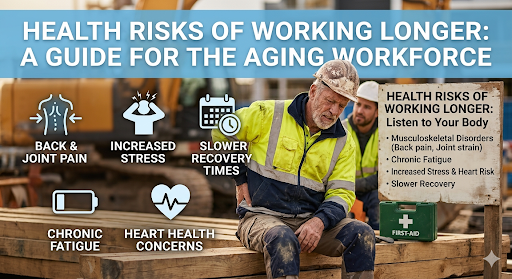
Bodies that have been working for 40 years carry the wear and tear of 40 years. That’s not defeatism — it’s biology. The health risks of working longer are felt most acutely by people in physically demanding jobs.
- Arthritis, joint pain and back problems worsen with continued physical strain
- Fatigue becomes harder to recover from as we age — a bad week at 65 hits differently than at 45
- Risk of workplace injury rises with age, particularly in manual or physical roles
- Long-term conditions such as heart disease, diabetes and COPD are harder to manage alongside full-time work
- Disrupted sleep — common in older adults — compounds physical exhaustion
Mental Health
The mental health dimension of working longer is just as important, and even less discussed. Being told you must continue working when your body and mind are ready to stop takes a real toll.
- Anxiety about the pension gap and financial pressure is already rising sharply among the 63 to 66 age group
- Loss of control over when you retire is strongly linked to depression in older workers
- Workplace stress — particularly in high-pressure or fast-paced environments — compounds existing conditions
- Feeling like the oldest person in the room, or experiencing age discrimination, affects confidence and wellbeing
- The inability to ‘switch off’ from work delays the mental transition into retirement
| ⚠️ IMPORTANT If a health condition is making it genuinely difficult to keep working, you may be entitled to Employment and Support Allowance (ESA) or Personal Independence Payment (PIP). These are not handouts — they are legal entitlements that exist precisely for situations like this. Talk to your GP or Citizens Advice. |
Who Faces the Greatest Health Risks From Working Longer?
The health risks of working longer are not shared equally. Some groups face a much harder path than others — and are also the least likely to have private savings to fall back on.
- Manual and trade workers — construction, plumbing, carpentry, agriculture
- Care and health workers — nursing, social care, support work
- Retail and hospitality workers — long hours on your feet, often with little flexibility
- People with existing health conditions — managing chronic illness alongside work is exhausting
- People struggling with rising household costs — with energy bills rising sharply for UK pensioners, working longer on a tight budget is doubly hard.
- Women who took career breaks — may have lower pension savings, making it harder to stop early
If you fall into one or more of these groups, the health risks of working longer are not abstract — they are likely already part of your daily life. Getting the right support in place now matters.
| 💡 HONEST TIP If your job is physically demanding and you’re struggling, speak to your GP and ask for a fit note. Your employer has a legal duty to consider reasonable adjustments. You do not have to simply push through and hope for the best. |
What Support Is Available If You’re Struggling?
There is more help available than most people realise — the problem is that it’s not always easy to find or claim. Here’s a straightforward breakdown.
From Your Employer
- Flexible working — you have a legal right to request this from day one of employment
- Reasonable adjustments — if you have a health condition or disability, your employer must consider these
- Phased retirement — reducing hours gradually rather than stopping all at once
- Occupational health referral — your employer may fund an assessment and support plan
From the Government
- Employment and Support Allowance (ESA) — if illness or disability prevents you from working
- Personal Independence Payment (PIP) — for long-term health conditions affecting daily life
- Universal Credit — may help bridge the gap between stopping work and receiving your pension
- Pension Credit — available once you reach state pension age, for those on low incomes
From the NHS
- NHS entitlements — including free prescriptions, eye tests and dental treatment. See our full guide to free NHS prescriptions over 60 for everything you’re entitled to.
- Talking Therapies — free NHS mental health support, no GP referral needed
- GP fit notes and occupational therapy referrals — document and manage the impact of work on your health
How to Protect Your Health If You Have to Keep Working
If stopping work isn’t an option right now, there are practical steps you can take to reduce the health risks of working longer and give yourself the best possible chance of reaching retirement in reasonable shape.
- Check your exact pension age — use the government checker at gov.uk. Your precise birth date matters more than ever now the age is rising gradually.
- Talk to your GP now — don’t wait until you’re struggling. Document any health conditions that are affected by work. This record matters if you later need to claim benefits.
- Request flexible working — even a small reduction in hours or a change in shift pattern can make a significant difference to your health.
- Use your annual leave — fully. Rest is not a luxury; it is a medical necessity, particularly for older workers managing health conditions.
- Look into your private or workplace pension — if you have one, when can you access it? From 2028, the minimum access age rises to 57, so check your options now.
- Don’t ignore your mental health — the NHS Talking Therapies service is free and doesn’t require a GP referral. Stress and anxiety about retirement are valid reasons to seek support.
- Know your rights — age discrimination is illegal. If you’re being treated differently because of your age, you can raise a formal complaint or contact ACAS.
Your Questions Answered
| What are the main health risks of working longer in the UK? |
| The main health risks of working longer include worsening musculoskeletal conditions such as arthritis and back pain, increased fatigue, higher risk of workplace injury, difficulty managing chronic conditions like diabetes or heart disease, and mental health impacts including anxiety and depression — particularly among those in physically demanding or high-stress roles. |
| Can I stop work early if my health is suffering? |
| Yes, in some cases. If a health condition makes it genuinely difficult to continue working, you may be entitled to Employment and Support Allowance (ESA) or Personal Independence Payment (PIP). Your GP can provide a fit note and refer you for support. Citizens Advice can help you understand your entitlements. |
| What is the state pension age in 2026? |
| From April 2026, the state pension age began rising from 66 to 67. The increase is being phased in gradually by birth date and will be fully in place by April 2028. Even a single day’s difference in your birthday can affect when you receive your first payment — so it’s worth checking your exact date at gov.uk. |
| What is the ‘financial gap year’ in retirement? |
| This is the term used for the period between when you stop working and when your state pension begins. If you planned to retire at 66 but must now wait until 67, you need to cover your living costs for that extra year — through savings, a private pension, or benefits. Planning ahead is essential. |
The Bottom Line
The health risks of working longer are real, they are significant, and for millions of people they are already being felt. The rise in state pension age to 67 is not just a financial issue — it is a health issue that deserves far more attention than it gets.
If you’re in good health and enjoy your work, an extra year or two may be manageable. But if you’re running on empty and wondering whether your home could help fund early retirement, our guide to equity release UK explains the honest pros and cons.
You have more choices than you might think. The key is finding out what they are before your health makes the decision for you.
| ✅ YOUR ACTION CHECKLIST Check your exact state pension age at gov.uk/check-state-pensionReview your private or workplace pension — when can you access it?Ask your employer about flexible working or phased retirementSee your GP if work is affecting your health — get it documentedCheck whether you’re eligible for PIP or ESATry NHS Talking Therapies if stress or anxiety is building upContact Citizens Advice if you need help understanding your benefitsSet up a Power of Attorney while you still can — essential if your health declines unexpectedly. |