
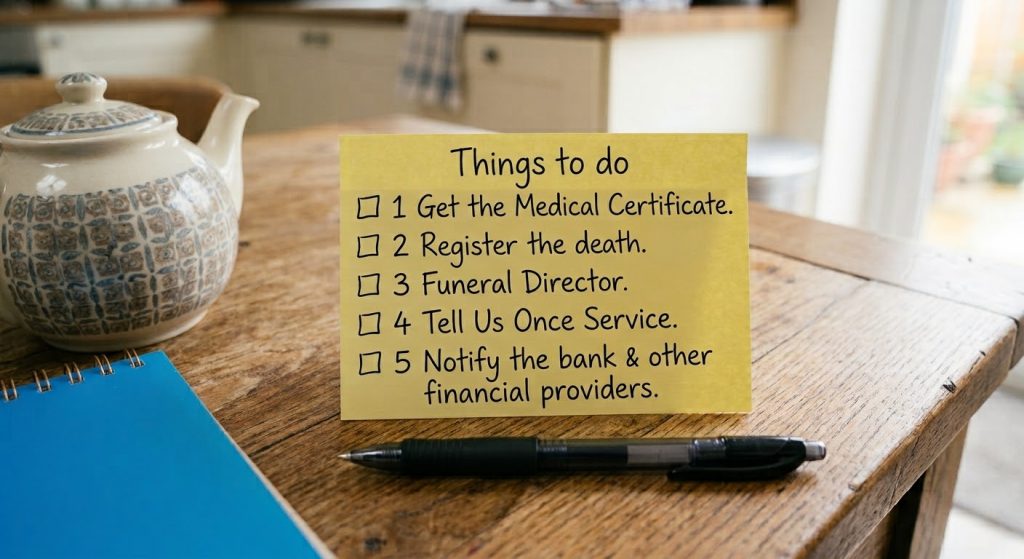
Losing someone close to you is one of the hardest things you’ll go through, and the last thing you need in the first few days is to wonder who to ring next. A well-meaning ad on social media recently boiled this down to five urgent calls: the GP, the funeral director, the register office, Tell Us Once, and the bank. That’s a decent starting point for a bereavement checklist, but the order matters more than it looks. Here’s what to do when someone dies, in the sequence that actually works, so you can get through the practical side without adding to the strain.
Your Bereavement Checklist at a Glance
This is a bereavement checklist of what to do, and in what order, in the first days and weeks after a death in the UK. Each step below leads to the one that follows, so working through them in this order avoids delays later.
- 1. Get the medical certificate — from the GP if someone dies at home, or from hospital staff if it happens there. You need this before you can register.
- 2. Register the death — within 5 days in England and Wales, 8 in Scotland. Order several certified copies while you’re there.
- 3. Start organising the funeral — check first for a pre-paid funeral plan, which is easy to miss but common.
- 4. Use the Tell Us Once service — one free call or form notifies HMRC, DWP, DVLA, the passport office and the council together.
- 5. Notify the bank and other financial providers — the bank, pension providers, insurers, and the mortgage lender if there is one.
That covers the essentials most bereavement checklists mention. Read on below for the detail behind each step, plus a few things a basic checklist often misses — from certified copies to wills, trusts, and benefits that don’t stop automatically.
The Steps to Take When Someone Dies, in Detail
Step 1: Get the Medical Certificate from the GP or Hospital
Before anything else can happen, you need the Medical Certificate of Cause of Death. If someone dies at home, the GP who was treating them will issue it, or you may need to call 111 if it happens outside surgery hours. If the death happened in hospital, staff will usually arrange this instead. You cannot record the death without this certificate, so it’s the genuine first call, whatever order a checklist online suggests.
Step 2: Record the Death
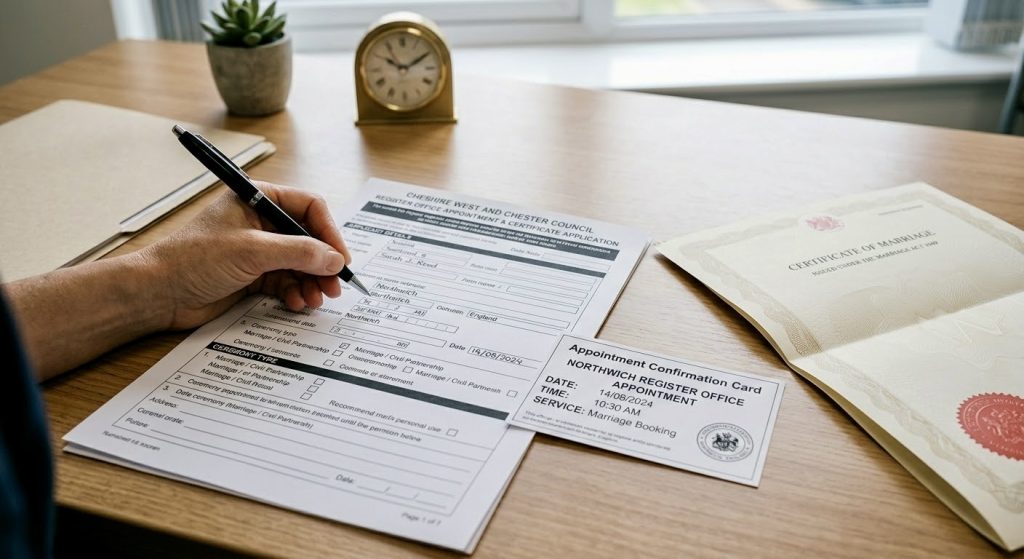
In England and Wales, a death must be registered within 5 days; in Scotland, within 8 days. You’ll need to book an appointment at the register office for the area where the death happened, and you’ll come away with the death certificate and a certified copies you’ll need throughout the process. Ask for several extra certified copies at this appointment — most banks, pension providers and insurers each want their own original, and reordering later costs more and takes longer.
Step 3: Arrange the Funeral
You don’t have to record the death before arranging a funeral, and in practice many families do this in parallel with Step 2. It’s worth checking first whether the person had a pre-paid funeral plan — these are easy to miss in the shock of the first few days, and paying for a funeral that was already covered is a common and costly mistake. Bank statements or a folder of paperwork are the usual places a plan turns up.
Costs vary widely and can catch families off guard — our guide to funeral costs for pensioners breaks down what to expect and where help is available.
Step 4: Use the Tell Us Once Service
Tell Us Once is a free government service that reports the death to most government departments in one go, including HMRC, DWP, the passport office, DVLA, and the local council. The register office will normally give you a reference number for this at your registration appointment. It’s genuinely one of the most time-saving parts of the whole process.
You can read more about eligibility and what’s covered on the gov.uk Tell Us Once page.
Step 5: Notify the Bank and Other Financial Providers
This is usually where families slow down, and understandably so. A death certificate is generally required before an account is closed or frozen, and it’s worth notifying the bank promptly, but not so promptly that a joint account gets frozen before urgent bills are covered. Alongside the main bank, don’t forget pension providers, life insurance, the mortgage lender if there is one, and any workplace pension schemes.
A Few Things a Basic Bereavement Checklist Misses
Having spent years advising on wills, trusts and funeral plans, the mistakes I see families make are rarely about forgetting a phone call. They’re about timing and paperwork.
- Order more certified copies of the death certificate than you think you’ll need — five or six is common.
- Check for a will before major decisions are made about the estate; if there’s a life interest trust involved, the rules can be more complex than they first appear.
- If the person was receiving Attendance Allowance or other benefits, these need to be stopped separately in some cases, even after Tell Us Once.
- Hold off on making irreversible decisions about property or care home fee accounts until probate is underway — acting too fast can create problems later.
Frequently Asked Questions
What should be on a bereavement checklist?
At minimum, a bereavement checklist should cover getting the medical certificate, registering the death, arranging the funeral, using Tell Us Once, and notifying the bank and other financial providers — plus checking for a will and any pre-paid funeral plan.
What are the first steps to take when someone dies?
If the death was expected, contact the GP or, if it happened in hospital, hospital staff, to get the process of confirming the death and issuing the medical certificate started. If the death was unexpected or unexplained, call 999 first.
How soon do I need to record the death?
Within 5 days in England and Wales, and within 8 days in Scotland, unless the death has been referred to a coroner, in which case the timescale changes.
Do I need a solicitor to deal with the estate?
Not always. It’s worth taking a moment to check if you need a solicitor: smaller, straightforward estates can often be dealt with by the family, especially where there’s a clear will. Larger estates, contested wills, or those involving a trust are usually worth taking advice on.
What if there’s no will?
The estate is distributed under the rules of intestacy, which follow a fixed order of relatives and don’t always match what the person would have wanted. It’s one of the strongest reasons to make a will while you still can.
None of this makes a difficult time easy, but a clear bereavement checklist — and knowing the traps that sit between each step — takes some of the pressure off at a moment when there’s little enough of that to spare.