
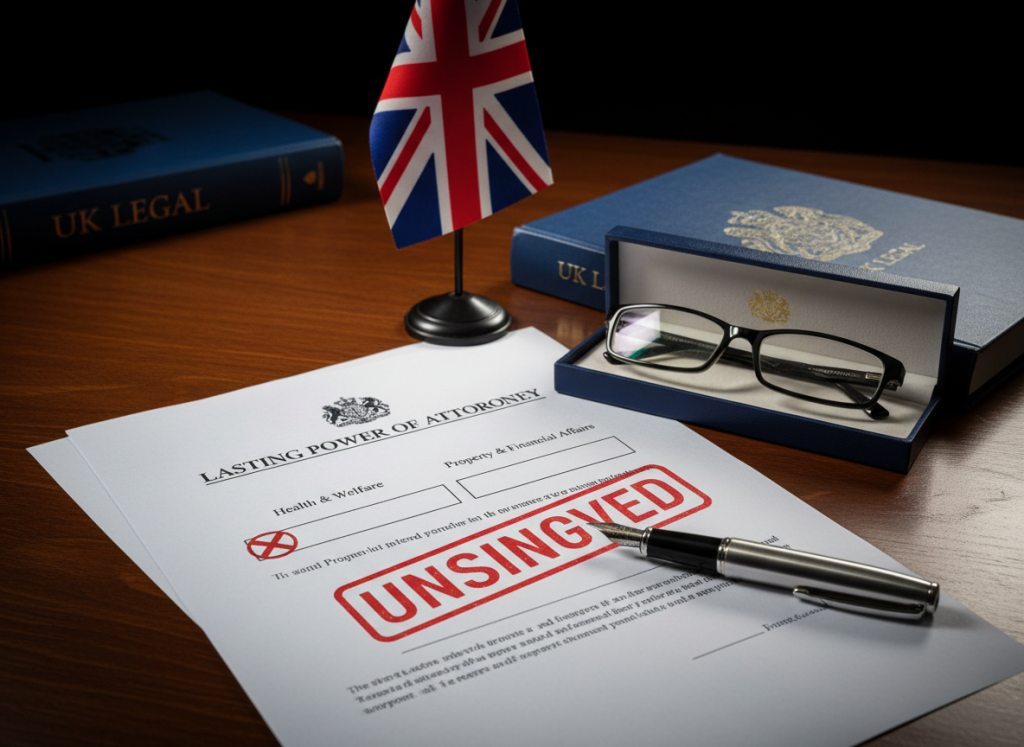
Introduction: The Document Most People Never Get Around To
Here’s a question worth sitting with for a moment. If you were suddenly unable to manage your own finances — due to a stroke, a dementia diagnosis, or a serious accident — who would pay your bills? Who would deal with your bank, your pension provider, your landlord or mortgage company? Who would make decisions about your care?
If the honest answer is ‘I’m not sure’, you’re not alone. Research from Legal & General found that fewer than one in three UK adults over 55 have a lasting power of attorney in place. Yet the Office of the Public Guardian processes over 900,000 new LPA applications every single year — which tells you how quickly this is becoming a mainstream necessity. Financial scams are another growing threat to pensioners — see our guide to scams targeting pensioners in the UK
A power of attorney UK is not a document you make when things go wrong. It’s a document you make while everything is fine — so that if things do go wrong, the people you trust are legally empowered to help you. Without it, even your closest family members have no legal right to manage your money or make decisions on your behalf. The consequences of that gap can be devastating, expensive, and very slow to resolve.
This article explains exactly what a power of attorney UK is, the two types you need to know about, what really happens if you don’t have one, and how to get it sorted simply and affordably.
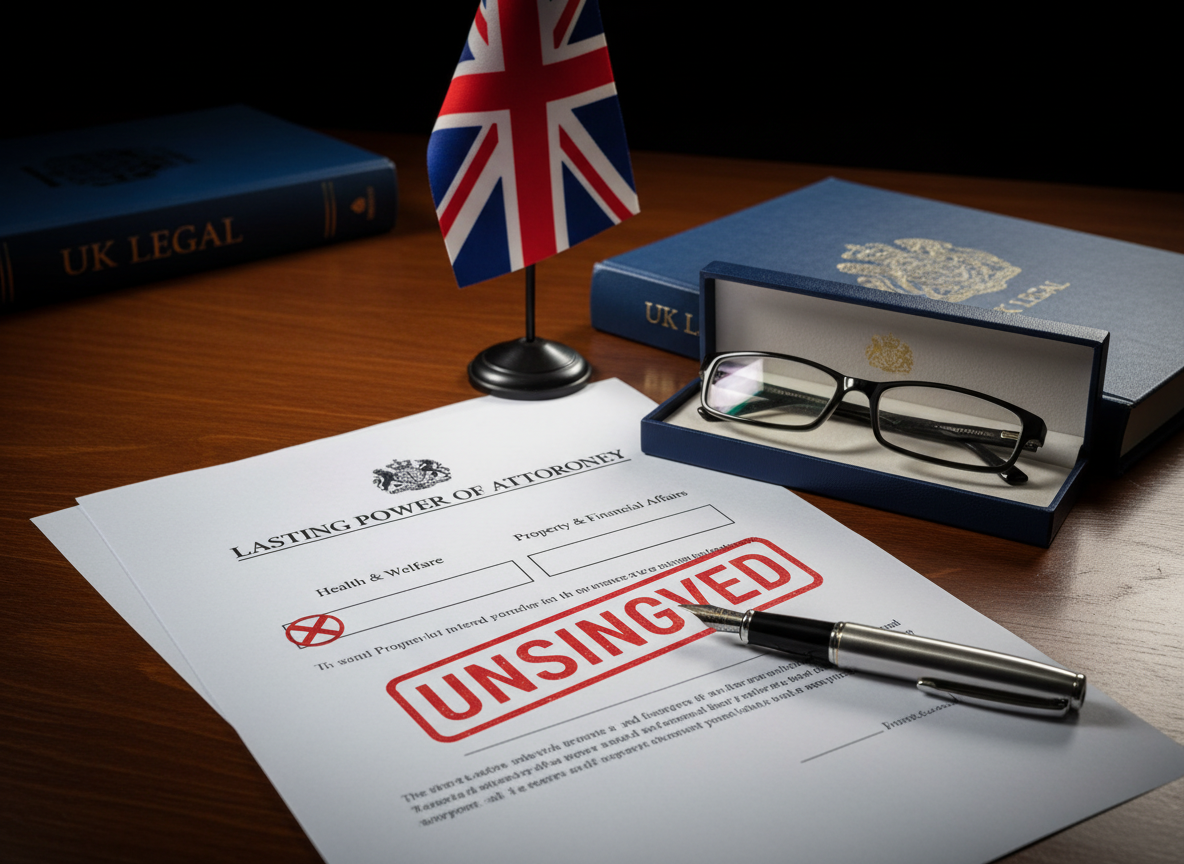
Setting up a power of attorney UK is one of the most important things you can do for yourself and the people you love — and it’s far easier than most people think.
What Is a Power of Attorney UK — and What Are the Two Types?
A power of attorney UK is a legal document that gives someone you trust — called your ‘attorney’ — the authority to make decisions on your behalf. That person doesn’t have to be a solicitor or a legal professional. It’s usually a spouse, adult child, close friend, or sibling. The key is that you choose them, while you have the mental capacity to do so.
In England and Wales, the relevant document is called a Lasting Power of Attorney (LPA). Scotland uses a Continuing Power of Attorney, and Northern Ireland uses an Enduring Power of Attorney. The principles are similar, but the legal processes differ slightly. This article focuses on England and Wales; Scottish and Northern Irish readers should check the relevant guidance from mygov.scot and nidirect respectively.
Type 1: Property and Financial Affairs LPA
This type of LPA gives your attorney the authority to manage your money and property. That includes:
- Accessing your bank accounts and managing everyday spending
- Paying your bills, mortgage, or rent
- Collecting your pension and benefits
- Buying or selling property on your behalf
- Managing investments and savings
You can set this up so it can be used straight away (useful if you need help now) or only once you’ve lost mental capacity. That’s your choice to make — and it’s worth thinking through carefully.
Type 2: Health and Welfare LPA
This type gives your attorney the power to make decisions about your personal care and medical treatment. That includes:
- Where you live — at home, with family, or in a care home
- Your day-to-day care routine — diet, clothing, daily activities
- Medical decisions, including whether to consent to or refuse treatment
- Life-sustaining treatment decisions, if you choose to include this
This type of LPA can only be used once you’ve lost mental capacity. It cannot be activated while you are still able to make your own decisions.
Practical tip: Most legal advisers recommend setting up both types at the same time. The registration fees are the same whether you do one or two, and the peace of mind is doubled.
What Really Happens If You Don’t Have a Power of Attorney UK
This is the section most people wish they’d read sooner. Because the consequences of not having a lasting power of attorney in place — when you need one — are not just inconvenient. They can be genuinely distressing, financially damaging, and take months or even years to resolve.
Your family has no automatic legal authority
This surprises almost everyone. Being someone’s spouse, child, or next of kin does not give you any legal right to manage their finances or make decisions about their care. If your partner loses capacity and there’s no LPA in place, their bank account is effectively frozen — even if your name is on a joint account in some circumstances.
Imagine not being able to pay the household bills, collect a pension, or access savings — because the account holder can no longer manage it themselves, and there’s no legal document saying you can step in.
The Court of Protection process is slow and expensive
If there’s no LPA in place and someone loses mental capacity, the only legal route is to apply to the Court of Protection to become a ‘deputy’. This is the formal process that gives someone legal authority to manage another person’s affairs when no LPA exists.
Here’s the problem. It typically takes between six and twelve months. The legal costs — including court fees, legal advice, and ongoing supervision costs — can easily exceed £3,000 to £5,000. And unlike an LPA, where you choose your attorney freely, the Court of Protection process involves supervision, reporting requirements, and annual fees for as long as the deputyship continues.
One family described it as ‘trying to run a marathon in concrete boots’. All they wanted to do was look after their mother’s finances. Instead, they spent nearly a year in legal process while bills went unpaid and care decisions were delayed.
Banks may freeze accounts without warning
When a bank becomes aware that a customer has lost mental capacity — whether through a medical notification, a family member disclosing this, or suspicious account activity — they are legally required to restrict access to that account until proper legal authority is presented. That means no withdrawals, no transfers, no direct debits. Without an LPA, that restriction can last months. Fraudsters also target pensioners whose accounts show signs of vulnerability — read our guide to bank scams in the UK to protect yourself.
The Critical Importance of Acting While You Still Can
Here is the single most important thing to understand about a power of attorney UK: you can only make one while you have mental capacity. Once you’ve lost the ability to understand what you’re signing and what it means, it’s too late. There is no backdating. There are no exceptions.
This is why the conversation so often comes too late. A diagnosis of dementia, a major stroke, or a serious accident can change everything very suddenly. And once mental capacity is gone, the window to make an LPA has closed permanently.
What ‘mental capacity’ actually means
Under the Mental Capacity Act 2005, a person has mental capacity if they can understand information relevant to a decision, retain it long enough to make the decision, weigh it up, and communicate their choice. Capacity is decision-specific — someone might have capacity for some decisions but not others.
Early-stage dementia does not automatically mean someone has lost capacity. Many people with an early diagnosis can still make a valid LPA — but time is genuinely of the essence. Don’t wait for a crisis. Make it while it’s straightforward.
The analogy that makes this clear
Think of a lasting power of attorney like a smoke alarm. You don’t fit a smoke alarm after the fire starts. You fit it when everything is fine, so that if the worst happens, you’re protected. An LPA works exactly the same way. You make it when you’re well, so that if your health changes, everything is already in place.
How to Set Up a Power of Attorney UK — Step by Step
The good news is that setting up an LPA is more straightforward than most people expect. You don’t need to use a solicitor, although many people find it helpful, especially if their situation is complex. Here’s how the process works.
Step 1: Choose your attorney or attorneys
Your attorney must be 18 or over and have mental capacity themselves. They should be someone you trust completely to act in your best interests — not their own. You can appoint more than one attorney, and specify whether they must act jointly (all decisions together) or jointly and severally (each can act independently). The latter is usually more practical for everyday decisions.
You can also appoint a replacement attorney, who steps in if your first choice is unable or unwilling to act. This is sensible forward planning.
Step 2: Complete the LPA forms
You can complete the LPA forms online through the GOV.UK Make a Lasting Power of Attorney service. The service guides you through each section clearly. You’ll need to nominate a certificate provider — someone independent (not a family member or the attorney) who confirms you understand what you’re signing and are acting freely. This can be a GP, solicitor, or anyone who has known you well for at least two years.
Step 3: Sign and witness
The LPA must be signed by you, your attorney(s), and your certificate provider in a specific order. Each signature must be witnessed. The Office of the Public Guardian guidance explains the exact signing order — getting this wrong is one of the most common reasons applications are rejected, so read it carefully.
Step 4: Register with the Office of the Public Guardian
An LPA is not legally valid until it has been registered with the Office of the Public Guardian (OPG). The registration fee is £82 per LPA (£164 for both types). Registration currently takes between 8 and 20 weeks, so plan ahead. If you’re on a low income or receive certain benefits, you may be eligible for a fee reduction or exemption — check the OPG fee remission guidance. If money is tight in retirement, it is also worth checking whether you could reduce other household costs — our guide to energy bills for UK pensioners covers six practical ways to cut costs right now.
Should you use a solicitor?
You don’t have to — but there are times when it makes sense. If your financial situation is complex, if you have a business, if there are family tensions that could complicate things, or if you simply want someone to check everything is done correctly, a solicitor’s fee of £300–£500 for both LPAs is money well spent. The Law Society’s solicitor finder can help you find a local specialist.
What to Watch Out For: LPA Scams and Misuse
Because a lasting power of attorney grants significant legal authority, it can unfortunately be misused. Financial abuse by attorneys — including family members — is more common than most people realise. The Office of the Public Guardian investigates thousands of concerns about attorney misconduct every year.
How to protect yourself
- Choose your attorney carefully. Trust is essential, but so is competence. Consider whether this person is genuinely able to manage financial and care decisions responsibly.
- Appoint more than one attorney where possible, acting jointly for major decisions — this provides a natural check on any single person’s authority.
- Tell someone you trust — a GP, a close friend, another family member — that an LPA exists and who your attorney is.
- Keep a copy of the registered LPA yourself, and ensure your attorney, bank, and GP have copies.
- If you suspect an attorney is misusing their authority, report it immediately to the Office of the Public Guardian or call 0300 456 0300.
Also be alert to LPA-related scams — firms that contact you claiming they can ‘check’ or ‘update’ your existing LPA for a fee. The OPG does not cold-contact people. Any unsolicited approach about your LPA should be treated with suspicion.
The Cost of an LPA vs. the Cost of Not Having One
Let’s be direct about this. The cost of setting up a power of attorney UK is modest — £164 in registration fees if you do both LPAs yourself online, or £300–£700 all-in if you use a solicitor. That’s a one-time cost. For those on low incomes, the OPG offers fee remissions, and some local Age UK and Citizens Advice services offer free or low-cost LPA assistance.
Now compare that to the cost of not having one. Court of Protection deputyship applications typically cost £3,000–£5,000 in legal fees alone, plus annual supervision fees of £320 or more. Add to that the financial disruption of frozen accounts, delayed care decisions, and the emotional toll on families trying to navigate a legal process while also managing a health crisis. The arithmetic is stark.
A real-world example
Margaret, 74, had a stroke that left her unable to communicate or manage her own affairs. She had never made an LPA. Her daughter spent eleven months and over £4,200 in legal costs applying to the Court of Protection to become her mother’s deputy. During that time, household bills fell behind, a planned care package was delayed, and the family was under enormous strain. ‘We kept thinking, why didn’t she just do it when she was well?’ her daughter said. ‘It would have taken an afternoon.’
Your Questions Answered: Power of Attorney UK
Q: Can I make a power of attorney UK myself, or do I need a solicitor?
You can make one yourself using the free GOV.UK LPA service. The online tool guides you through the process step by step. However, if your situation is complex — for example, if you have a business, significant assets, family disagreements, or are concerned about a specific health condition — a solicitor can provide valuable reassurance that everything is correctly completed. The Law Society can help you find a local specialist in later-life planning.
Q: What happens to my bank account if I lose mental capacity and have no LPA?
Your bank is legally required to restrict access to your account once they become aware you’ve lost mental capacity, and no LPA is in place. That means no one — including your spouse or children — can access your money without going through the Court of Protection. That process typically takes six to twelve months and costs several thousand pounds. During that time, bills can go unpaid, direct debits can lapse, and care arrangements can be severely disrupted.
Q: Can a power of attorney UK be revoked if I change my mind?
Yes — as long as you still have mental capacity, you can revoke an LPA at any time. You’ll need to notify your attorney(s) in writing and inform the Office of the Public Guardian to update their records. If your attorney dies, loses capacity, or is removed, the OPG should also be informed. Any replacement attorneys you originally nominated would then step in.
Q: Is a power of attorney UK the same as a will?
No — and this is a very common misconception. A will deals with what happens to your estate after you die. A power of attorney UK deals with what happens while you are alive but unable to make your own decisions. Both are important. They serve completely different purposes and one does not replace the other. If you have a will but no LPA — or an LPA but no will — your planning is incomplete. The Money and Pensions Service offers free, impartial guidance on both. Planning your finances in retirement goes hand in hand with planning for the future — our guide to funeral plans in the UK is a useful next step.
Final Word: Don’t Leave This for Later
A power of attorney UK is one of those things that feels easy to put off. You’re fine right now. The family would figure it out. You’ll get around to it. But every person who has been through the Court of Protection process without an LPA in place — or every family who has watched a loved one’s finances freeze while care decisions stalled — will tell you the same thing: do it now, while it’s simple.
It doesn’t take long. It doesn’t have to be expensive. And once it’s done and registered, it sits quietly in the background — hopefully never needed. But if it is needed, it could be the most important document you ever signed.
Talk to the people you trust. Decide who you’d want making decisions for you. Then make it official. Your future self — and your family — will be grateful you did.
★ Your action steps this week:
- Visit GOV.UK and read through the LPA guide — it takes around 20 minutes.
- Have a conversation with the person (or people) you’d trust as your attorney.
- Check if you qualify for a fee remission at gov.uk/power-of-attorney/costs.
- If your situation is complex, find a local solicitor via the Law Society finder.
- Once registered, make sure your bank, GP, and key family members know the LPA exists and where to find it.
Useful Contacts
- Office of the Public Guardian: 0300 456 0300
- Make an LPA online:
- Court of Protection:
- Law Society solicitor finder:
- MoneyHelper (free guidance):
- Age UK helpline: 0800 678 1602
- Citizens Advice: 0808 223 1133
- Scotland — Continuing Power of Attorney:
- Northern Ireland — Enduring Power of Attorney: