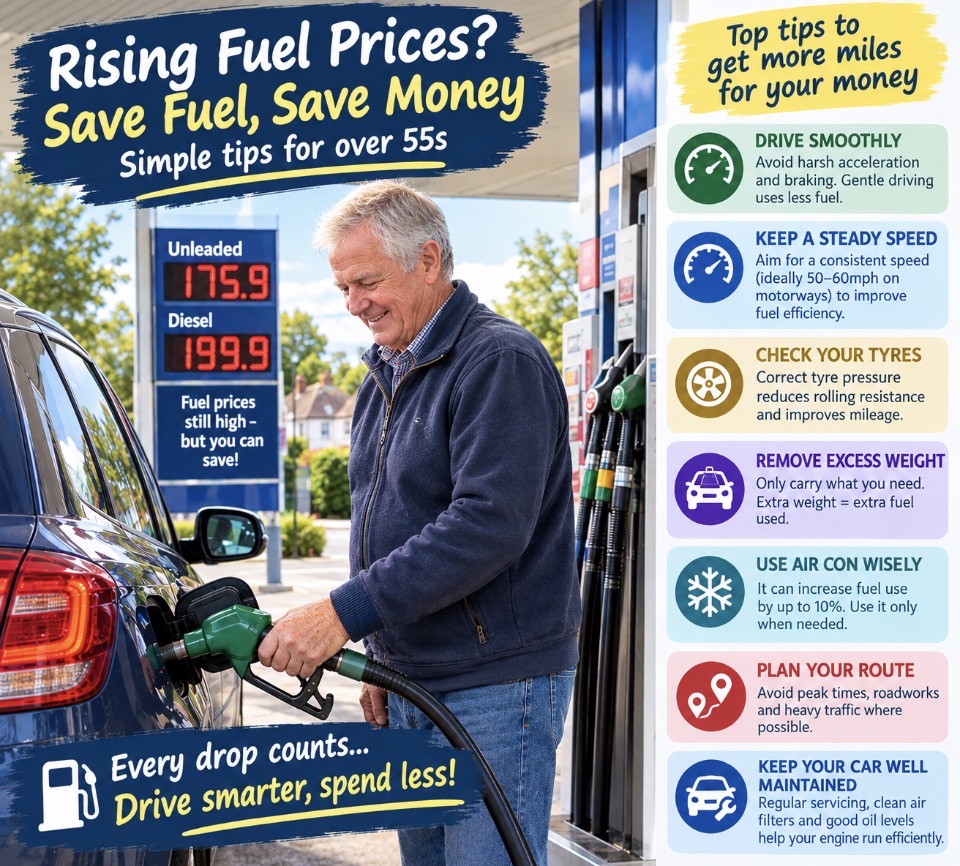
Diesel has just topped £2 a litre for the first time, and the AA says filling an average 55-litre tank now costs around £110 for diesel and £96 for petrol. Knowing how to save fuel has gone from a nice-to-have to a necessity. If you are over 55 and living on a pension or a reduced income, there is no pay rise to soak up a 10p jump at the pump. It comes straight out of the food shop or the heating budget.
The good news is that most fuel savings cost nothing. They come from how you drive, where you fill up and how often you take the car out at all. Google Maps now shows live fuel prices at forecourts near you, so finding the cheapest pump takes seconds. And from January 2027, a new £2 bus fare cap across England gives many of us a genuine alternative to driving.
My wife and I spend three hours a day delivering parcels locally, mainly for the exercise and a chat with our regular customers. The money is a welcome bonus, keeping us out of our savings and paying for our holidays. It’s also stop-start driving at its worst, and it’s taught me more about fuel economy than any leaflet. On a busy day I can watch the gauge drop far faster than on a motorway run. Every harsh pull-away costs money, while smooth, gentle driving makes a real difference by the end of the week.
Table of Contents
What Fuel Is Really Costing You in Retirement
Fuel is easy to underestimate because we pay for it a tankful at a time. Add it up over a year and the numbers are sobering. Here is what a typical 8,000 miles a year costs at today’s average prices:
| Car | Price per litre | Yearly fuel cost | 10% saving |
| Petrol, 40mpg | £1.75 | £1,591 | £159 |
| Diesel, 50mpg | £2.00 | £1,455 | £145 |
A 10% saving is realistic for most drivers just by changing a few habits. That is roughly £145 to £160 a year, money that could cover a month of council tax or a good chunk of your car insurance. That is why knowing how to save fuel matters so much on a fixed income.
How to Save Fuel Behind the Wheel
The way you drive has more effect on your fuel bill than almost anything else. None of these tips will make your journey noticeably slower.
1. Drive smoothly and look ahead
The single biggest lesson in how to save fuel is to drive smoothly. Harsh acceleration and late braking are the biggest fuel wasters. Every time you brake, you throw away energy you paid for. Look well down the road, ease off early when you see a red light or a queue, and let the car roll. In my delivery driving, smooth anticipation makes a bigger difference than anything else.
2. Ease off the speed
Government figures suggest that driving at 70mph uses up to 9% more fuel than driving at 60mph, and up to 15% more than at 50mph. On a long motorway trip, sitting at 60 to 65mph in the inside lanes can save several pounds and adds only a few minutes.
3. Change up early
In a manual car, change up at around 2,000rpm in a diesel or 2,500rpm in a petrol. If your car has a gear-change indicator or an Eco mode, use it. It is there to save you money.
4. Don’t coast in neutral
It is an old habit, but it no longer saves fuel. Modern cars cut the fuel supply completely when you lift off the accelerator in gear. Coasting in neutral actually uses more fuel to keep the engine idling, and it reduces your control of the car.
5. Use air conditioning wisely
Air con makes the engine work harder. Around town, open a window instead. At motorway speeds, open windows create drag, so air con is usually the better choice. In winter, a quick blast clears misted windows faster, which matters more for safety than the fuel it uses.
How to Save Fuel Before You Set Off
Some of the easiest savings happen before you even turn the key.
6. Check your tyre pressures monthly
If you want to know how to save fuel without changing how you drive, start with your tyres. Under-inflated tyres increase rolling resistance and wear out faster. Check them when the tyres are cold, using the pressures in your handbook or on the sticker inside the driver’s door. Most supermarket forecourts have a free or low-cost air machine.
7. Lose the extra weight and the roof box
Clear out the golf clubs, garden bags and boxes that have lived in the boot since the last car boot sale. More importantly, take off roof bars and roof boxes when you are not using them. They add a surprising amount of wind resistance at higher speeds.
8. Combine your short trips
A cold engine uses far more fuel for the first few miles. Five separate short trips in a week, each starting from cold, can use much more fuel than one longer trip covering all the same errands. Plan a single round for the chemist, the post office and the supermarket. It is one of the simplest answers I know to the question of how to save fuel in retirement.
9. Keep up with servicing
A well-maintained car with clean filters, fresh oil and correctly aligned wheels runs more efficiently. Skipping a service to save money now can cost you more in fuel and repairs later.
How to Save Fuel by Finding the Cheapest Pump
Prices can vary by many pence a litre between forecourts in the same town, so where you fill up matters.
10. Check Google Maps for live fuel prices near you
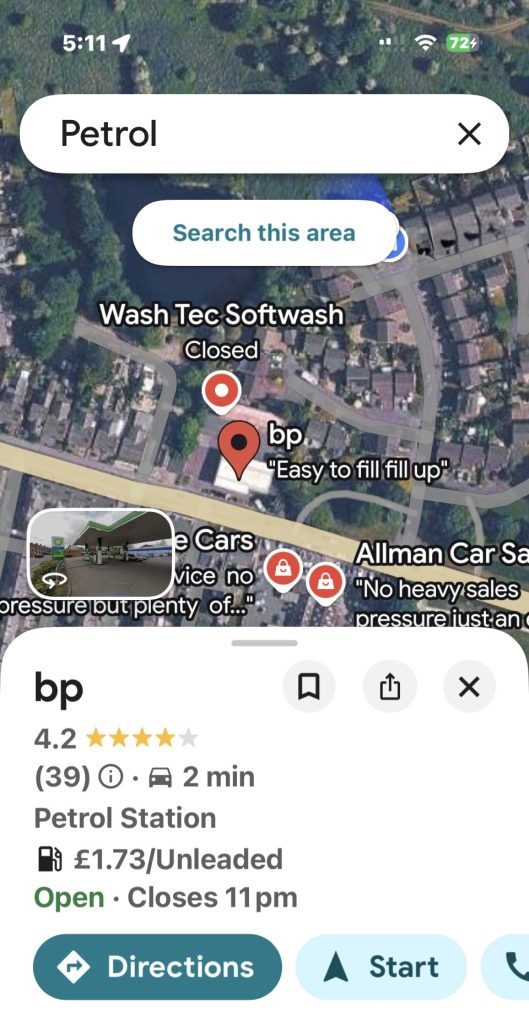
From 8 October 2026, Google Maps shows fuel prices in the UK. Search for petrol stations in the app and you will see each forecourt on the map along with its price per litre. The prices come from the Government’s Fuel Finder scheme, which since February has legally required every forecourt to report a price change within 30 minutes. As reported by BBC News, Ofcom figures show around three in four British adults already use Google Maps, so for most of us this is the simplest way to find cheaper fuel.
In a few seconds you can spot the cheapest forecourt before you set off, rather than finding out at the pump. The gap is often bigger than people expect. At the end of July 2026, the cheapest petrol in the UK was 139.9p a litre and the dearest 198p, a difference of nearly £32 on a single tank.
iPhone users, take note: Apple Maps, the map app that comes with your iPhone, does not show fuel prices. Download the free Google Maps app from the App Store instead. If you already use Waze, it shows the same prices.
If a forecourt shows no price, that is deliberate. Google says it checks the data itself and only displays a price when it is confident the figure is up to date. That matters, because the scheme is not perfect. PetrolPrices told the BBC that some forecourts have not signed up at all, and that around 200 did not appear to update their diesel prices on time in September. Treat any price as a strong guide rather than a guarantee.
A quick tip: only go out of your way if the saving is worth it. Driving three extra miles to save 2p a litre on a half-tank will cost you more than you save. The best saving is a cheaper forecourt on a route you were already taking. When the Fuel Finder scheme launched, the Government estimated it could save households around £40 a year.
For anyone wondering how to save fuel at the pump itself, Google Maps is now the quickest tool. If you prefer a dedicated app, PetrolPrices and the RAC and AA apps also show live prices. National averages are published on RAC Fuel Watch.
11. Favour supermarkets and avoid motorway services
Supermarket forecourts are usually among the cheapest, and loyalty points can knock a little more off. If you are already a Costco member, its fuel is often cheaper still. Motorway services are almost always the most expensive place to fill up, often 20p to 30p a litre more than nearby towns, so top up before a long journey rather than during it.
12. Do You Still Need Two Cars?
For couples asking how to save fuel and money together, this is where the real savings are. Fuel is only part of the cost of running a car. Insurance, road tax, the MOT, servicing, tyres and depreciation can easily add up to well over a thousand pounds a year on a second car that spends most of its life on the drive.
If one of you could manage with the bus for most journeys, selling the second car could save far more than any driving technique. Sit down together, list the trips each car makes in a typical week, and be honest about which ones really need it.
The £2 Bus Fare Cap: How to Save Fuel by Leaving the Car at Home
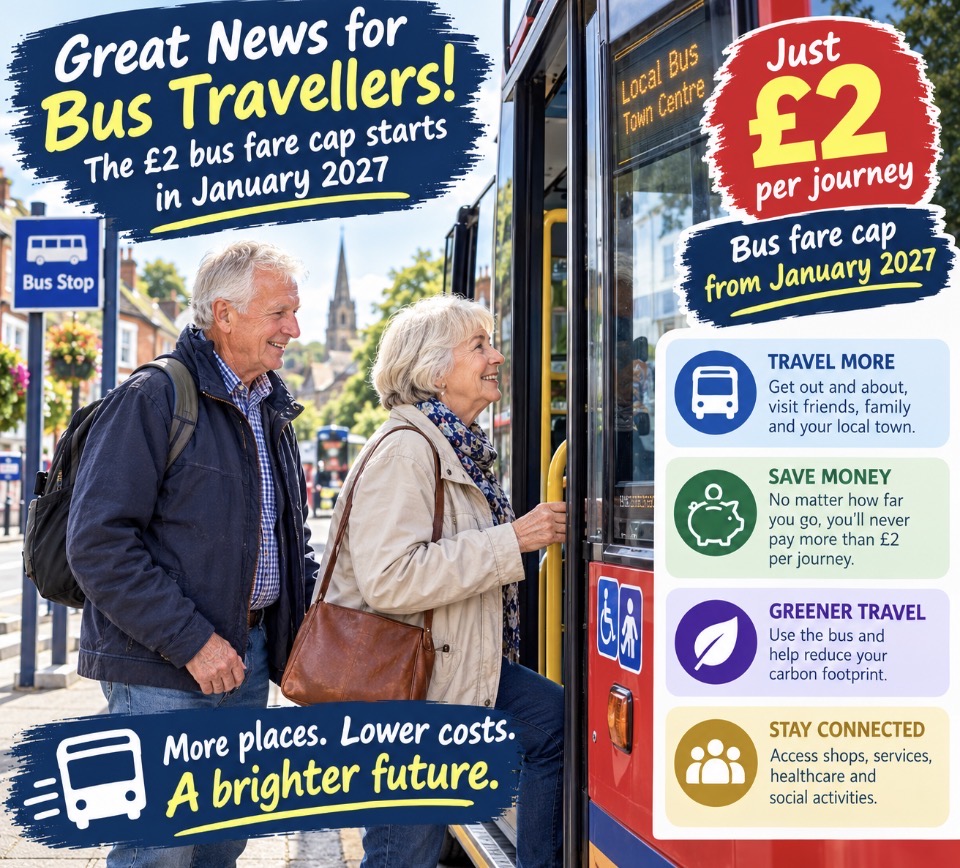
Sometimes the best answer to how to save fuel is not to use any. Prime Minister Andy Burnham has announced that single bus fares across England will be capped at £2 from January 2027, down from the current £3 cap. He brought in the same £2 cap in Greater Manchester as mayor, and kept it there when the national limit was raised. The new cap is backed by £454 million of Government funding and is set to apply throughout 2027.
For over 55s, who benefits depends on your age:
- Aged 55 to State Pension age: This is the group that gains most. You probably do not have a free bus pass yet, so every journey is paid for. A £2 cap makes the bus a realistic option for town trips, especially if you have retired early or work part-time.
- Older person’s bus pass holders: In England, the free pass covers off-peak travel, from 9.30am to 11pm on weekdays and all day at weekends and on bank holidays. If you need to travel earlier, for an early hospital appointment or part-time work, the £2 cap will cut the cost of those journeys.
Remember that the free bus pass in England is linked to State Pension age, which is rising from 66 to 67 between 2026 and 2028. You can check your eligibility and apply on GOV.UK. Scotland, Wales and Northern Ireland have their own concessionary schemes, and the £2 cap applies to England only.
Is the bus actually cheaper than driving?
Honestly, not always, especially if you travel as a couple. A six-mile round trip into town in a 40mpg petrol car uses about £1.20 of fuel at £1.75 a litre. On the bus, a return trip costs up to £4 each under the new cap, so £8 for two of you. Even after paying for town-centre parking, driving together will often work out cheaper.
The sums change when you travel alone and parking is expensive, or when you have bus passes and travel off-peak. If you both have a pass, the bus is free. If only one of you does, the other pays up to £4, which is much closer to the cost of fuel plus parking.
The bigger saving comes when using the bus regularly means you can drive less overall, or give up a second car altogether. Find out more in our guides to Free Bus Pass Changes 2026 and Over 60s Coach Holidays.
Is a Hybrid or Electric Car Worth It?
If you are thinking longer term about how to save fuel, a hybrid or electric car may be worth a look. If your car is due for replacement anyway, a hybrid or electric vehicle could cut your running costs, particularly if most of your driving is local and you can charge at home on an off-peak tariff. The Government’s move to remove VAT from household electricity bills makes home charging a little cheaper too.
But do not rush to change a reliable car just to save on fuel. The upfront cost of a newer vehicle can take many years to recover through fuel savings, especially if you only drive a few thousand miles a year. Do the sums for your own mileage first.
The Bottom Line
You cannot control the price at the pump, but you can control a surprising amount of what you spend on it. Learning how to save fuel comes down to three things: drive more smoothly, check Google Maps before you fill up, and drive less when there is a cheaper alternative. With the £2 bus cap arriving in January, that alternative is about to get a lot more attractive for many over 55s.
For more ways to stretch your retirement income, see our guide to Eating Well on a Pension
Frequently Asked Questions
What driving technique can help save fuel?
Driving smoothly and anticipating the road ahead makes the biggest difference for most
people. Avoiding harsh acceleration and late braking, keeping your speed down on
motorways and keeping your tyres properly inflated can together cut fuel use by around
10%.
Is 70 or 80 mph more fuel efficient?
70mph is more fuel efficient, and 80mph is also above the UK motorway speed limit. Fuel
use rises sharply with speed because wind resistance increases. Government figures
suggest that driving at 70mph uses up to 9% more fuel than 60mph, and the jump from 70 to
80mph costs considerably more again.
Is 12 litres per 100km good?
No, it is fairly thirsty. 12 litres per 100km works out at about 23.5 miles per gallon. Most
modern family cars manage 40 to 50mpg, which is around 5.5 to 7 litres per 100km. If your
car is returning figures like this on everyday journeys, check your tyre pressures and
servicing, and look at how many short, cold-engine trips you make.
What are 10 ways to save fuel?
Drive smoothly, ease off the speed, change up early, avoid coasting in neutral, use air con
wisely, check your tyre pressures, remove roof boxes and extra weight, combine short trips,
keep up with servicing, and check Google Maps for the cheapest fuel near you before filling
up.
How can I find the cheapest petrol near me?
Open the Google Maps app and search for petrol stations. Since 8 October 2026 it shows
live prices at nearby forecourts, using the Government’s Fuel Finder data. Apple Maps does
not show prices, so iPhone users should download Google Maps or use an app such as
PetrolPrices.
Why does Google Maps show no price for some petrol stations?
Google only displays a price when it is confident the figure is current. If a forecourt has not
reported its latest price to Fuel Finder, you will see the station but no price.
Does air conditioning use more fuel?
Yes, air con puts extra load on the engine. Around town, opening a window is usually more
economical. At motorway speeds, open windows create drag, so using air con is often the
better option.
Is premium fuel worth the extra cost?
For most everyday cars, no. Unless your handbook says your car needs super unleaded,
standard fuel will do the job. The extra cost per litre is unlikely to be recovered in improved
economy.
Is supermarket fuel lower quality than Shell or BP?
No. All petrol and diesel sold in the UK must meet the same British Standards (BS EN 228
for petrol and BS EN 590 for diesel), wherever you buy it. Supermarkets and the big brands
often draw fuel from the same refineries and storage terminals. The main difference is the
additive package each retailer mixes in, such as detergents that help keep the engine clean,
and supermarket fuel has its own additives too. For an everyday car, supermarket fuel is
perfectly fine, and the AA and RAC both say so.
When does the £2 bus fare cap start?
The £2 cap on single bus fares across England is due to start in January 2027, replacing the
current £3 cap. It applies to everyone, not just older passengers.
Can I use my free bus pass before 9.30am?
In England, the older person’s bus pass is only guaranteed for off-peak travel, from 9.30am
on weekdays. Some councils allow earlier travel, so check with your local authority.
Otherwise, journeys before 9.30am will be covered by the new £2 cap from January 2027.