
Introduction: The Criminals Have Got Better. Have We?
Fraud is no longer something that happens to other people. In 2025, the UK recorded 444,000 cases of fraud — the highest figure ever logged in a single year. That’s more than 1,200 cases every single day.
Bank scams UK figures have never been higher, and behind every statistic is a real person: someone who answered a phone call that seemed genuine, clicked a link that looked trustworthy, or discovered too late that a stranger had been living their financial life for months.
Fraud now makes up 45% of all crime in England and Wales, according to the National Crime Agency. It has overtaken burglary, vehicle theft, and violent crime combined. And the criminals driving it aren’t opportunists working alone. They are organised networks using artificial intelligence to make their approaches more convincing, more personal, and harder to spot than ever before.
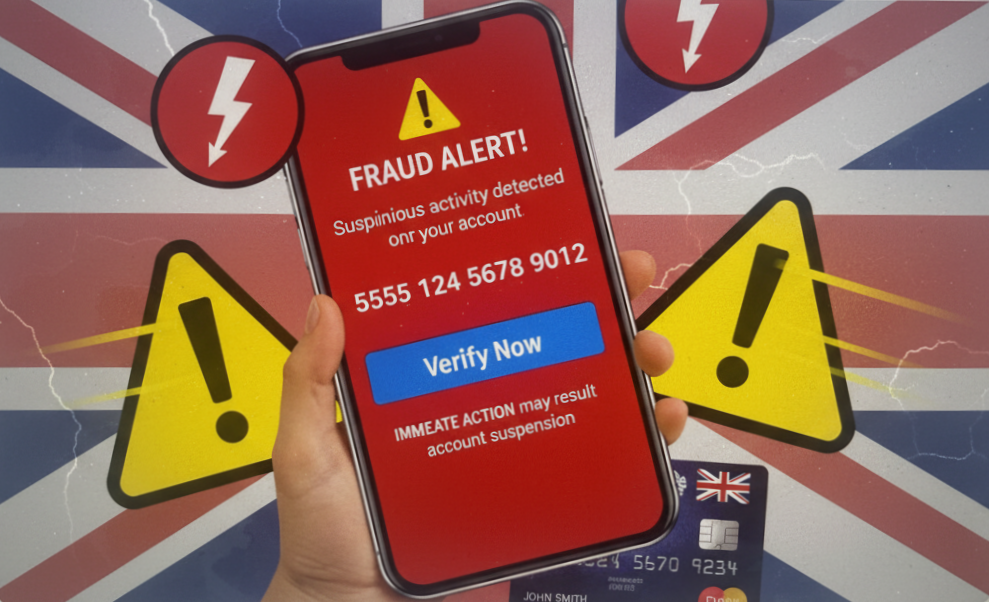
If you’re over 55 and managing on a fixed income, bank scams UK are a direct and growing threat to your financial security. Scammers also target pensioners through investment offers and doorstep fraud — see our full guide to scams targeting pensioners in the UK. There are 2 specific types of fraud surging right now that every pensioner needs to understand. One targets your bank account directly. The other steals something even harder to recover: your identity. This article explains both clearly — no jargon, no scaremongering, just the facts you need and the steps that will genuinely protect you.
Bank Scams UK: Scam #1 — When You’re Tricked Into Sending the Money Yourself
The name sounds technical. The scam is devastatingly simple.
Authorised Push Payment fraud — or APP fraud — is when a criminal convinces you to transfer money from your own bank account directly to theirs. You authorise the payment yourself. The bank processes it. And the money is gone. It is one of the most common and fastest-growing bank scams in the UK right now — and it works precisely because it doesn’t look like a scam at all.
In the first half of 2025 alone, £257.5 million was stolen through APP fraud in the UK — a 12% increase on the same period the year before. The most common trigger? A phone call, text message, or email that appears to come from your bank.
The Safe Account Call: The Scam That Sounds Like a Rescue
Here’s how the most common version of these phone banking scams plays out.
You receive a call from someone claiming to be from your bank’s fraud department. They’re calm, professional, and very convincing. They tell you that suspicious activity has been detected on your account. They say your money is at risk. To protect it, they’ll need you to transfer your funds to a ‘safe account’ they’ve set up on your behalf.
They may already know your name, your sort code, even the last few digits of your card number. This makes them seem completely legitimate. They’ll often tell you not to mention the call to anyone — including other bank staff — because the investigation is sensitive.
The safe account, of course, belongs to the criminal. By the time you realise what’s happened, the money has already moved on — often internationally, within hours.
| ⚠️ The Golden Rule — Never Break It No genuine bank, building society, or police officer will ever ask you to transfer money to a ‘safe account’. Ever. Not for any reason. If you hear those words — hang up immediately. |
The Invoice Redirect Scam: Targeting Homebuyers and Tradespeople
This version of phone banking scams is particularly cruel because it targets people at the moment of a major financial transaction — buying a home, paying a builder, or settling a large professional invoice.
A criminal intercepts an email chain between you and your solicitor, estate agent, or tradesperson. If you are buying a property or managing large financial decisions, a power of attorney can also protect your finances if you become unable to manage them yourself. They send you a message that looks exactly like one from the genuine company, telling you that their bank details have changed and asking you to send your next payment to a new account.
Because you’re expecting to make a payment, and because the email looks identical to the real thing, many people comply without question. HSBC’s fraud guidance notes that criminals often compromise email accounts to pull this off — which means the scam can begin without the victim doing anything wrong at all.
What These Bank Scams Look Like in 2026
Bank scams in the UK are becoming more sophisticated every month. Criminals are now using AI to clone voices, mimic writing styles, and create fake but convincing websites. A survey by Barclays found that only 36% of UK adults feel confident they could identify an AI-powered scam. Among older adults, that figure is likely lower.
Some of the most common approaches right now include:
- Phone calls impersonating your bank, HMRC, or the police
- Fake text messages with urgent warnings about account security
- WhatsApp messages pretending to be from a family member in trouble — known as the ‘Hi Mum’ scam
- Emails claiming to be from a solicitor or tradesperson with updated payment details
- Investment offers promising high guaranteed returns, promoted through social media
For a full guide to phone fraud including the new AI voice cloning threat, see our dedicated article on phone scams UK.
How to Protect Yourself from Bank Scams
These steps are practical, free, and effective:
- If you receive an unexpected call about your bank account, hang up. Call your bank back using the number on the back of your card — never use a number given to you by the caller.
- Never transfer money to a ‘safe account’. Banks don’t have them. If someone tells you to, it’s a scam.
- Before paying any invoice — especially for property or large services — call the company directly on a number you already know to verify their bank details haven’t changed.
- Be suspicious of any urgent request. Legitimate organisations don’t panic you into transferring money on the spot.
- If you are managing finances on a fixed income, it is also worth reviewing your best savings accounts for UK pensioners — keeping money spread across accounts reduces your exposure if one is compromised.
| 💡 New Rules From October 2024 From October 2024, new PSR reimbursement rules mean most banks must refund APP fraud victims — but you must report it quickly. Contact your bank immediately if you think you’ve been caught out, then report to Action Fraud on 0300 123 2040. |
Bank Scams UK: Scam #2 — Identity Theft and How It Works
The second of the major bank scams UK pensioners face is identity theft — and it’s often the slower, more silent threat. Someone steals enough of your personal information to impersonate you, then uses that identity to open credit cards, take out loans, access your accounts, or make purchases in your name.
According to the Cifas Fraudscape 2026 report — the most comprehensive fraud data available in the UK — identity fraud accounted for more than 242,000 cases in 2025, making it the single most common type of fraud recorded in the National Fraud Database for the fourth consecutive year. It now makes up over half of all fraud reports.
And the people being targeted? Cifas data consistently shows that those aged 61 and over account for around a quarter of all identity fraud victims. The targeting is deliberate.
How Your Identity Gets Stolen
You might imagine that identity theft requires something dramatic — a burglary, a hacked computer, a complex cyberattack. Sometimes it does. But often, it begins with something much more ordinary.
The most common ways criminals get hold of your personal information include:
- Data breaches — when companies you’ve used are hacked and your details are exposed. Check if your email has been involved at haveibeenpwned.com
- Phishing emails or fake websites — that trick you into entering your name, date of birth, National Insurance number, or banking details
- Mail theft — bank statements, HMRC letters, or utility bills taken from your letterbox contain enough information to impersonate you
- Social media oversharing — date of birth, home town, and mother’s maiden name are often visible to strangers online — and are exactly the security questions banks use
- Criminal marketplaces — fraudsters buy stolen personal details in bulk from the dark web
Think of your personal information like a jigsaw. Any one piece on its own isn’t enough. But name plus date of birth plus address plus National Insurance number? That’s the full picture — and a criminal can use it to become you.
Warning Signs Your Identity May Have Been Stolen
Identity fraud often doesn’t announce itself. Instead of an alarm, you might notice:
- Credit applications you didn’t make appearing on your credit report
- Unexpected bills or debt collection letters for accounts you don’t recognise
- Being declined for credit despite having no history of financial difficulty
- Mail going missing, or your address being changed on existing accounts without your knowledge
- Small, unusual charges on your bank or credit card statement
By the time any of these appear, the fraud may have been going on for weeks or months. The earlier you catch it, the easier it is to resolve.
How to Protect Your Identity in 2026
These are the most effective steps you can take right now, without needing any technical knowledge:
- Check your credit file regularly. Experian, Equifax and TransUnion all offer free basic credit reports. Look for accounts you don’t recognise. Set a reminder every three months.
- Sign up for Cifas Protective Registration. For £25 for two years, Cifas flags your record so lenders take extra steps before approving any application in your name.
- Shred all financial documents before binning them. Bank statements, utility bills, NHS letters, HMRC correspondence — any of these can be used by a fraudster. A basic cross-cut shredder costs around £20.
- Opt out of the open electoral roll. Contact your local council to opt out of the edited register — it doesn’t affect your right to vote.
- Be cautious about what you share on social media. Never post your full date of birth, home address, or details about financial accounts.
- Use a unique, strong password for your email account and enable two-step verification. Your email is the master key to almost everything else.
| 🚨 If You Think Your Identity Has Been Stolen Contact your bank immediately. Report to Action Fraud: 0300 123 2040 Contact Experian, Equifax and TransUnion to flag a fraud alert on your file. Report to Cifas at cifas.org.uk |
Why These Two Bank Scams Are Linked — and Why That Matters
Understanding bank scams in the UK means recognising that these two threats rarely operate in isolation. APP fraud and identity theft aren’t always separate events — often, one enables the other. Protecting your finances also means planning ahead — our guide to power of attorney in the UK explains how to ensure a trusted person can step in legally if a scam leaves you unable to manage your own affairs.
A criminal who steals your identity first — getting your name, date of birth, National Insurance number, and address — can use that information to pass your bank’s security checks when calling. That’s what makes the safe account call so convincing: the fraudster already knows things that feel private. You assume only your bank could know those details. But your bank wasn’t the source.
Similarly, a successful APP fraud often starts with a phishing message that first harvests some of your personal information. The financial theft and the identity theft are increasingly part of the same criminal operation.
Understanding this connection helps you see why the same core rules apply to both:
- Slow down whenever money or personal information is involved
- Verify independently before you act on any request
- Never assume that someone knowing your details makes them genuine
- Report anything suspicious quickly — early action significantly improves outcomes
| 📖 Related Reading on Honest Pensioner 7 Consumer Alerts for UK Pensioners That Fraudsters Hope You Never See honestpensioner.com/consumer-alerts-for-uk-pensioners/ Power of Attorney UK: What Every Pensioner Needs to Know Before It’s Too Late honestpensioner.com/power-of-attorney-uk/ |
Your Questions Answered
These are the questions we hear most from Honest Pensioner readers about bank scams.
Q1: What are the most common bank scams UK pensioners fall victim to?
The two most common bank scams UK pensioners encounter are Authorised Push Payment (APP) fraud — particularly the ‘safe account’ phone call — and identity theft. In APP fraud, you’re tricked into transferring money yourself. In identity theft, a criminal steals your personal details and uses them to impersonate you with lenders and banks.
Both are rising sharply, and both are increasingly sophisticated. The good news is that the same core protection applies to both: slow down, verify independently, and never act on urgency alone.
Q2: Will my bank refund me if I’ve been the victim of a bank scam?
Since October 2024, new rules from the Payment Systems Regulator (PSR) require most UK banks to reimburse APP fraud victims in the majority of cases. However, reimbursement is not automatic — you must report the fraud to your bank immediately and then separately to Action Fraud on 0300 123 2040. The sooner you act, the stronger your position. Reimbursement may not apply if the bank believes you ignored clear warnings or were grossly negligent.
Q3: My bank called me and already knew my account details. Doesn’t that prove they’re genuine?
Unfortunately, no. This is one of the most misunderstood aspects of phone banking scams. Fraudsters routinely research victims using data from previous breaches. Knowing your name, partial card number, sort code, or even recent transactions does not confirm the caller is from your bank.
Real bank fraud teams never ask you to transfer money, never ask for your full PIN, and never tell you to keep the call secret. If you receive a call like this, hang up and call your bank on the number on the back of your card. Wait at least five minutes, or use a different phone — some scammers stay on the line.
Q4: What is Cifas Protective Registration and is it worth it?
Cifas Protective Registration is one of the most underused protections available to UK pensioners worried about bank scams. When you register, a flag is placed against your name in the National Fraud Database. This means any Cifas member lender must take extra steps to verify your identity before approving any credit application in your name — making it significantly harder for a fraudster to succeed. It costs £25 for two years and is available at cifas.org.uk.
Final Word: You Can’t Stop Every Scam. But You Can Stop Most of Them.
The criminals behind bank scams in the UK are professionals. They’re well-funded, well-organised, and increasingly powered by technology that makes their approaches more convincing by the month. That’s the uncomfortable reality.
But here’s the other reality: most fraud succeeds not because it’s technically unstoppable, but because it catches people off-guard. It uses urgency, authority, and trust to bypass your better judgement before you have time to think.
The single most protective thing you can do is slow down. Every genuine organisation — your bank, HMRC, your solicitor, your pension provider — will give you time to verify before you act. The ones who won’t? They’re telling you everything you need to know.
Take ten minutes this week to do three things: check your credit file, review your online privacy settings, and make sure two-step verification is turned on for your email and banking apps. Those three steps alone will put you significantly ahead of where most people are. It is also worth checking whether rising energy bills are putting unnecessary pressure on your budget — an area where many pensioners are overpaying without realising it.
And if something feels wrong, trust that instinct. Call your bank on the number you already have. Talk to a family member. Share this article with someone who needs it — because the best protection against bank scams UK pensioners face is simply knowing what to look for. And now you do.
| ✅ Your Protection Checklist 1. Save your bank’s phone number in your contacts — use it to call back, never a number given to you 2. Never transfer money to a ‘safe account’ — banks don’t have them 3. Verify invoice bank details by phone before paying — especially for property 4. Check your credit file every three months — Experian, Equifax, TransUnion all offer free access 5. Sign up for Cifas Protective Registration — £25 for two years at cifas.org.uk 6. Shred all financial documents before binning 7. Enable two-step verification on your email and banking apps 8. If in doubt, wait — legitimate organisations will always give you time |
| 🏷️ Suggested Tags Core topic (3): bank scams UK, identity theft UK, APP fraud UK Subtopic (3): authorised push payment fraud, Cifas protective registration, safe account scam Audience / intent (2): UK pensioners, fraud protection over 60s Ready to copy: bank scams UK, identity theft UK, APP fraud UK, authorised push payment fraud, Cifas protective registration, safe account scam, UK pensioners, fraud protection over 60s |
Useful Contacts
- Action Fraud: 0300 123 2040 | actionfraud.police.uk
- Cifas Protective Registration: cifas.org.uk (£25 for two years)
- Take Five to Stop Fraud: takefive-stopfraud.org.uk
- Check for data breaches: haveibeenpwned.com (free)
- FCA ScamSmart: fca.org.uk/scamsmart