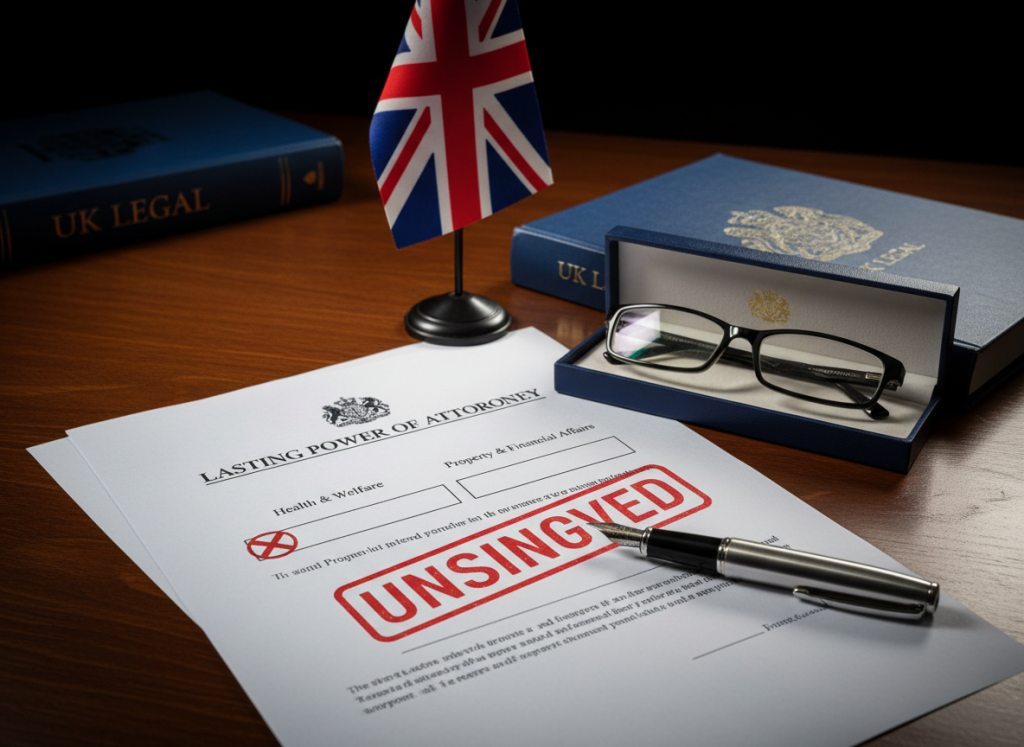
Did you know that if you die without a will in the UK, the law — not you — decides who gets everything you’ve spent a lifetime building? It sounds alarming. But it happens every single day.
More than half of UK adults — over 56% in 2025 — died without leaving a valid will. That means millions of families were left to deal with legal chaos, unexpected costs, and painful disputes, all while trying to grieve. [Source: Bangor University, 2026]
Most people put off making a will because they think it’s something to sort out ‘later.’ They assume their spouse will automatically get everything, or that because they’re not particularly wealthy, it doesn’t really matter. Unfortunately, neither of those assumptions is guaranteed to be true.
When you die without a will in the UK — known legally as dying ‘intestate’ — a set of rules written over 100 years ago takes over. These rules don’t know your family, your wishes, or your circumstances. And the consequences can be deeply unfair.
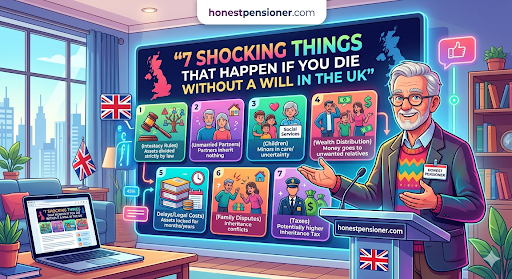
Here are 7 shocking things that can happen — and what you can do to protect your family today.
What Does It Mean to Die Without a Will in the UK?
When you die without a will in the UK, you’re said to have died intestate. It simply means: the law takes over your estate.
Instead of your wishes being followed, a set of legal rules called the Rules of Intestacy — set out in the Administration of Estates Act 1925 — decide who gets what. These rules were written over 100 years ago and don’t account for modern families, cohabiting couples, blended households, or your specific wishes.
Here’s what that can mean in practice.
1. Your Unmarried Partner Could Be Left With Nothing
This is probably the most shocking consequence of choosing to die without a will in the UK — and sadly one of the most common.
Despite what many people believe, there is no such thing as a ‘common law spouse‘ in English law. Nearly half of Brits wrongly believe that living together for a long time gives their partner automatic inheritance rights. It doesn’t. [Source: wuhld.com]
If you’re not married or in a civil partnership, your partner has no automatic right to inherit anything from your estate — regardless of how long you’ve lived together, whether you own a home together, or whether you have children.
What happens instead?
Your estate passes to your children, or your parents, or your siblings — in that order — under the intestacy rules. Your partner could be left fighting an expensive legal battle just to stay in the home you shared.
| ⚠️ A REAL FAMILY TRAGEDY — AND A WARNING During my years as a mortgage broker, I came across a story that has stayed with me ever since. A husband and wife had two young boys together. The mother died. The father remarried — and neither he nor his new wife ever got around to making a will . When the father died suddenly of a heart attack, everything passed automatically to his new wife. The house. The car. His pension. His savings. Even money that had been left specifically for the two boys by their late mother — money the father had been holding in a separate savings account in his name for them. The two boys received nothing. I was later told that the boys would sometimes sit on the pavement outside their old family home, watching their stepbrother driving their dad’s car. Don’t let this kind of tragedy happen to your family. A will would have taken an hour to sort out and would have changed everything. |
2. Your Spouse Might Not Inherit Everything
Even if you’re married, when you die without a will in the UK, your spouse doesn’t automatically receive your entire estate.
Under the current intestacy rules, if your estate is worth more than £322,000, your spouse receives the first £322,000 plus half of whatever remains. The other half goes to your children — even if they’re adults and financially independent. [Source: Citizens Advice]
Why does this matter for pensioners?
If most of your wealth is tied up in your home — which is the case for millions of UK pensioners — your spouse could end up co-owning the property with your children. This can cause real practical problems: disagreements about selling, pressure to downsize, or costly legal disputes at the worst possible time.
3. Stepchildren Are Completely Excluded
The intestacy rules only recognise biological or legally adopted children. Stepchildren — even if you raised them as your own for decades — have no automatic right to inherit if you die without a will in the UK.
For blended families, this can be devastating. A stepchild you loved and supported for years could receive nothing, while relatives you’ve barely spoken to could receive a share of your estate.
The only way to protect stepchildren is to name them explicitly in a valid will.
4. Probate Takes Much Longer — and Costs More
Dealing with someone’s estate after death is never easy. But it becomes significantly harder when you die without a will in the UK.
Without a will, the legal process is known as applying for Letters of Administration rather than standard probate. This takes longer, involves more paperwork, and often requires professional legal help.
How much longer are we talking?
- With a valid will: probate typically takes 6–9 months
- Without a will: the process often takes 9–12 months or more [Source: wuhld.com]
That’s months of additional stress for your loved ones — at the worst possible time. Legal fees can also be considerably higher without a will in place.
5. The Wrong Person Could End Up in Charge of Your Estate
A will lets you appoint an executor — someone you trust to carry out your wishes and manage your estate. Without one, the law decides who administers everything.
In practice, this is usually your next of kin. But what if your next of kin is someone you’ve fallen out with? Or someone who lives abroad? Or someone who simply isn’t up to the task?
There’s also a serious legal risk: an estate administrator can be held personally financially liable for any mistakes they make — even genuine errors. [Source: Co-op Legal Services]
A will puts you in control of who handles things — and protects them legally too.
6. No Guardian Is Named for Dependants in Your Care
If you have dependent children or grandchildren in your care, choosing to die without a will in the UK means no guardian is officially appointed. This decision is left entirely to the courts.
Even if the outcome is ultimately what you’d have wanted, the process takes time — and during that time, your loved ones’ lives could be thrown into real uncertainty.
A will is the only legal way to name the person you want to look after them.
7. Your Estate Could Go to the Crown
This sounds unlikely — but it happens more than you’d think.
If you die without a will in the UK and have no surviving relatives recognised under the intestacy rules, your entire estate passes to the Crown. This is known as bona vacantia — Latin for ‘ownerless goods.’
Friends, charities you cared about, distant relatives not covered by the rules — none of them would receive a penny. The government takes it all.
A simple will redirects your estate exactly where you want it to go.
| ✅ QUICK CHECKLIST: DO YOU NEED A WILL? You probably need a will if any of the following apply: • You’re unmarried but living with a partner • You have stepchildren you want to provide for • Your estate (home + savings + possessions) is worth more than £322,000 • You want to leave something to a friend or charity • You want to choose who manages your estate • You have a blended family or complicated family situation • You want to appoint a guardian for dependants If any of these apply — and for most over-55s, several will — it’s time to act. |
What Should You Do? How to Make a Will in the UK
The good news is that making a will doesn’t have to be complicated or expensive. Here are your main options:
- Solicitor: Best for complex estates. Costs typically £300–£600 for a straightforward will. Use a solicitor regulated by the Solicitors Regulation Authority (SRA) (external link).
- Online will services: Suitable for straightforward situations. Can cost as little as £90–£150. Look for services that use qualified solicitors to check your will.
- Will-writing charities: Some organisations offer free or discounted will-writing services. Age UK and similar charities sometimes run schemes. See our guide on legal rights and planning for pensioners (internal link).
What makes a will legally valid in the UK?
Your will must be:
- Written down (typed or handwritten)
- Signed by you
- Witnessed by two independent adults who are not beneficiaries in the will
- Your beneficaries need to know where to find your will or where it is stored.
Once those four things are in place, your will is legally binding and overrides the intestacy rules entirely. [Source: wuhld.com]
| ❓ YOUR QUESTIONS ANSWERED Q: What happens when you die without a will in the UK if you’re married? A: If your estate is worth more than £322,000 and you have children, your spouse only receives the first £322,000 plus half of the remainder. The other half goes to your children. A will lets you decide exactly how your estate is divided. Q: Can my unmarried partner inherit if I die without a will in the UK? A: No. Unmarried partners have no automatic inheritance rights under UK law, regardless of how long you’ve been together. The only way to protect your partner is to name them in a valid will. Q: Do stepchildren inherit if you die without a will in the UK? A: No. The intestacy rules only recognise biological or legally adopted children. Stepchildren are completely excluded unless named in a will. Q: How much does it cost to make a will in the UK? A: A straightforward will through a solicitor typically costs £300–£600. Online services can cost as little as £90–£150. Some charities offer free will-writing services, they expect you to leave them a donation when you pass away. The cost of not having a will is almost always far higher. |
The Bottom Line: Don’t Die Without a Will in the UK
If there’s one thing I hope you take away from this article, it’s this: to die without a will in the UK is to hand control of everything you’ve worked for to a set of rules that know nothing about you or the people you love.
It affects ordinary families every single day — leaving partners unprotected, stepchildren excluded, and loved ones stuck in months of legal complexity and heartbreak.
Making a will is one of the most straightforward, affordable things you can do to protect your family. It doesn’t take long. It doesn’t have to cost a fortune. And it gives you complete peace of mind.
Should either you or your partner die then the surviving spouse should make a new will immediately and the same goes for couples that divorce later in life.
Don’t leave it until ‘later.’ Later has a habit of arriving too sooner than you THINK.
| 📌 WHAT TO DO NEXT 1. Check whether you already have a will — and if so, when you last updated it. 2. If you don’t have one, get a quote from a regulated solicitor or a reputable online will service. 3. Tell your executor where your will is kept. 4. Review your will after any major life change — marriage, divorce, new grandchildren, moving home. For more plain-English guidance on your legal rights as a pensioner, visit our Legal & Wills section at honestpensioner.com/category/legal-and-wills |