Every single day in the UK, criminals steal more than £48,000 from people’s pension pots. Not from banks. Not from businesses. From ordinary men and women who spent decades carefully putting money aside for a retirement they’d earned.
That’s not a figure plucked from a tabloid. That’s the real number from Action Fraud — based on reported cases alone. And the actual total is almost certainly far higher.
Why? Because the Financial Conduct Authority estimates that fewer than one in five pension scams are ever reported. Shame, confusion, and disbelief all play a part. Many victims don’t even realise they’ve been scammed until months or years later.
pension scams UK 2026 cost savers £17.5 million across 519 reported cases in 2024. The average victim lost around £47,000 [MoneyHelper]. That’s often an entire lifetime of savings — gone in a single phone call. The scale of pension scams UK 2026 is far greater than most people realise.
And here’s the part that catches most people off guard: these scammers don’t look like scammers. They have professional websites, glossy brochures, persuasive scripts, and answers for every objection. Some victims are financially experienced, sharp people who simply couldn’t tell the difference.
This guide explains what pension scams UK 2026 look like, the four most common types targeting UK pensioners right now, the red flags to watch for — and exactly what to do if you think you’ve been targeted.
Why Pension Savers Are a Prime Target
Think about it from a fraudster’s point of view. Where is the most concentrated pool of accessible money in the UK? It isn’t in current accounts or savings ISAs. It’s in pension pots — often holding tens or hundreds of thousands of pounds built up over a working lifetime. Pension scams UK 2026 are specifically designed to exploit that concentration of wealth.
Pension savings are also attractive for another reason: most people don’t engage with them closely until they’re approaching retirement. That long gap in attention is exactly what criminals exploit. You might not notice something has gone wrong for months, or even years — by which point it’s too late.
A recent Age UK survey of 10,000 people aged over 50 found that a staggering 41% had already been scammed in the last five years [LexisNexis Risk]. Scammers are increasingly using digital tools — including AI-generated voices and cloned websites — making their approaches harder to detect than ever.
The 2015 pension freedoms reforms, which gave people far greater flexibility over how they access their savings, were genuinely a gift to fraudsters. More freedom meant more opportunities to persuade savers to transfer money into schemes the scammers controlled.
If you’d like to understand more about protecting yourself from callers claiming to be your bank or pension provider, see our guide on phone scams targeting UK pensioners.
The 4 Types of Pension Scam You Need to Know About
Not all pension scams work the same way. Knowing the different types makes them far easier to spot. Here are the four most common forms active in the UK right now.
1. Pension Transfer Scams
This is the most common type. A fraudster — often posing as a financial adviser or pension specialist — persuades you to transfer your pension pot into a new scheme they control. They might offer a ‘free pension review’ and claim your current provider is underperforming. Once your money arrives in the new scheme, it disappears.
pension transfer scam UK cases typically begin the same way: an unsolicited call, text, or social media message. According to solicitor Anthony Wilson of Copious Law, who has represented many fraud victims, most pension scams follow one of three patterns — a free review offer, a transfer to ‘better’ investments, or an offer to release tax-free cash.
2. Pension Liberation Fraud
This scam targets people who need cash quickly. It promises early access to pension funds — often before the age of 55 — through a supposed ‘loophole’. There is no loophole. Pension scams UK 2026 of this type are particularly cruel because victims not only lose their savings but face HMRC tax penalties of up to 55% of the amount withdrawn on top.
In January 2026, two men were jailed at Leeds Crown Court for running a pension liberation scheme that stole £3.7 million from 74 victims. They used professionally produced brochures and offered cashback incentives — all to disguise straightforward theft. One fraudster received an 11-year sentence.
3. Account Takeover and Impersonation
A newer, fast-growing threat. Criminals obtain your personal details — through phishing emails, fake websites, or data breaches — then impersonate you to access your pension account directly. Once in, they redirect payments to their own accounts. The Pension Scams Action Group flagged this as one of the fastest-growing methods going into 2026 [The Pensions Regulator].
4. AI-Enhanced Investment Scams
This is the newest — and frankly the most alarming — development. Scammers are now using artificial intelligence to generate convincing voice calls, fake financial adviser videos, and professional-looking investment literature. You might receive a call that sounds exactly like someone from your pension provider. It isn’t.
These scams promise unusually high investment returns — often in overseas property, renewable energy bonds, or cryptocurrency — with little or no risk. If someone promises you guaranteed returns and zero downside, that is your biggest red flag of all.
| ⚠️ WARNING: Cold Calling About Pensions Is Illegal If you receive an unsolicited phone call about your pension — offering a free review, early access, or a better deal — that call is illegal. Cold calling about pensions has been banned in the UK since 2019. You are under no obligation to stay on the line. Hang up, then report it to the Information Commissioner’s Office (ICO) at ico.org.uk or call 0303 123 1113. |
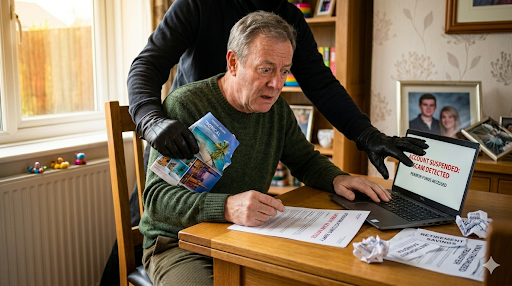
How to Spot a Pension Scam: The Red Flags
Knowing how to spot a pension scam [moneyhelper-scam] is genuinely your best line of defence against pension scams UK 2026. The good news is that most scams share the same warning signs. Learn these, and you’re already far better protected than the average person.
Pension Fraud Warning Signs Checklist
- Unsolicited contact — a phone call, text, email or social media message you weren’t expecting, about your pension.
- Pressure to decide quickly — phrases like ‘this offer expires today’ or ‘limited places available’. Legitimate advisers never rush you.
- Guaranteed high returns — all genuine investments carry risk. Anyone promising guaranteed returns is not telling the truth.
- Offer to unlock your pension early — look out for words like ‘loophole’, ‘liberation’, ‘loan’, ‘savings advance’, or ‘cashback’ from your pension.
- Overseas investments — storage units, overseas property, parking spaces, forestry. These sit outside UK financial protections entirely.
- Complicated structures — if you can’t clearly understand where your money will go and how you’ll get it back, that’s deliberate.
- Only a mobile number or PO box — legitimate firms have registered addresses and landline numbers. Verify them.
- They warn you against your own provider — scammers sometimes claim your existing provider is ‘blocking’ you or ‘trying to keep your money’. This is false. Your provider has a legal duty to run due diligence checks on any transfer.
These are the key pension fraud warning signs [tpr-scams] identified by The Pensions Regulator and the FCA. If you spot even one of them, stop all contact immediately. immediately.
| ✔ TIP: Always Check the FCA Register First Before transferring your pension or engaging with any financial firm, check whether they’re authorised on the FCA Financial Services Register. Also check the FCA ScamSmart warning list for firms known to be operating illegally. If they’re not on the register, stop all contact immediately. |
How to Spot a Pension Scam: The Red Flags
Knowing how to spot a pension scam [moneyhelper-scam] is genuinely your best line of defence against pension scams UK 2026. The good news is that most scams share the same warning signs. Learn these, and you’re already far better protected than the average person.
Pension Fraud Warning Signs Checklist
- Unsolicited contact — a phone call, text, email or social media message you weren’t expecting, about your pension.
- Pressure to decide quickly — phrases like ‘this offer expires today’ or ‘limited places available’. Legitimate advisers never rush you.
- Guaranteed high returns — all genuine investments carry risk. Anyone promising guaranteed returns is not telling the truth.
- Offer to unlock your pension early — look out for words like ‘loophole’, ‘liberation’, ‘loan’, ‘savings advance’, or ‘cashback’ from your pension.
- Overseas investments — storage units, overseas property, parking spaces, forestry. These sit outside UK financial protections entirely.
- Complicated structures — if you can’t clearly understand where your money will go and how you’ll get it back, that’s deliberate.
- Only a mobile number or PO box — legitimate firms have registered addresses and landline numbers. Verify them.
- They warn you against your own provider — scammers sometimes claim your existing provider is ‘blocking’ you or ‘trying to keep your money’. This is false. Your provider has a legal duty to run due diligence checks on any transfer.
These are the key pension fraud warning signs identified by The Pensions Regulator and the FCA. If you spot even one of them, stop all contact immediately.
You may also want to read our guide on Power of Attorney in the UK — a key legal safeguard if you’re concerned about someone taking financial control on your behalf.
| Q&A: Your Questions Answered |
Q1: How do pension scams UK 2026 typically start?
Most pension scams UK 2026 begin with unsolicited contact — a cold call, text message, email, or social media approach. The scammer typically offers a free pension review, a time-limited investment opportunity, or promises of early access to your pension. Cold calling about pensions has been illegal in the UK since 2019. If you receive unsolicited contact about your pension from anyone, treat it as a scam until proven otherwise.
Q2: How do I know how to spot a pension scam?
The key to how to spot a pension scam is knowing the red flags: pressure to decide quickly, guaranteed returns, offers to unlock your pension before 55, contact you didn’t initiate, and investment in unusual or overseas assets. Always check any firm on the FCA Financial Services Register at register.fca.org.uk before handing over any information or money. If something feels wrong, trust that instinct and seek independent advice from a regulated adviser.
Q3: What are the most common pension fraud warning signs?
The most important pension fraud warning signs are: unsolicited contact about your pension, pressure to act quickly, promises of guaranteed high returns, language like ‘loophole’, ‘liberation’ or ‘cashback’, only a mobile number or PO box as contact details, and suggestions that your current provider is ‘blocking’ you. Any single one of these should make you stop immediately and seek advice from MoneyHelper or a regulated financial adviser.
Q4: Can I get my money back if I’ve fallen for a pension transfer scam UK?
If you’ve been the victim of a pension transfer scam UK, recovery is possible but not guaranteed. Report to Action Fraud immediately on 0300 123 2040. Contact your pension provider — they may be able to stop an in-progress transfer. The Fraud Compensation Fund has paid out over £81.5 million to scam victims since 2020, but eligibility depends on the type of scheme involved. Act fast: the sooner you report, the better your chances.
⭐ Key Takeaways
- Pension scams UK 2026 cost savers £17.5 million in 2024 — more than £48,000 stolen every single day.
- Fewer than one in five scams are reported, so the real total is far higher.
- The four main types are: transfer scams, liberation fraud, account takeover, and AI-enhanced investment scams.
- Cold calling about pensions is illegal in the UK. Hang up.
- How to spot a pension scam: pressure tactics, guaranteed returns, early access offers, or any contact you didn’t initiate.
- Always check the FCA register before engaging with any adviser or firm.
- If targeted: call Action Fraud on 0300 123 2040 and your pension provider immediately.
- Compensation exists but isn’t guaranteed — prevention is always the better outcome.
Don’t Let the Fraudsters Win
Your pension isn’t just a pot of money. It’s decades of hard work, careful saving, and planning for the retirement you’ve earned. Pension scams UK 2026 are specifically targeting people like you — and the criminals behind them are counting on you not knowing the warning signs.
But now you do. Keep this article bookmarked. Share it with a friend or family member who has a pension. And if something doesn’t feel right about a call or offer you’ve received, trust that instinct.
For further guidance, visit MoneyHelper’s pension scam guidance, check the FCA ScamSmart website, or explore our Scams & Fraud section for more articles written specifically for UK pensioners.
| 💬 Worried You’ve Been Contacted by a Scammer? Don’t be embarrassed — these are professional criminals. Report it to Action Fraud on 0300 123 2040. If you’d like guidance, browse our Scams & Fraud section for practical, plain-English advice. |
Honest Pensioner | honestpensioner.com | Article prepared April 2026