
| ⚠️ Important: This article is for general information only PIP rules are complex and depend on your individual circumstances. This article does not constitute financial or legal advice. Always check your personal position with Citizens Advice, Age UK, or a benefits specialist before taking action. |
More than 3.9 million people in England and Wales currently claim PIP — and up to 800,000 of them could lose part or all of their daily living payment when new rules eventually take effect. But here is the news that matters right now: the government has just delayed the most feared PIP changes 2026. If you are over 55, have a health condition, or care for someone who does, this is essential reading.
PIP — Personal Independence Payment — is worth up to £10,119 a year. It is tax-free, not means-tested, and paid on top of your State Pension. Yet millions of people who qualify are not claiming it. And for those already receiving it, the proposed rule changes caused serious alarm earlier this year.
This guide explains exactly what the PIP changes 2026 mean, what has been delayed, what is actually changing right now, and — most importantly — what you should do next.
What Are the PIP Changes 2026?
Earlier this year, the government proposed a significant tightening of PIP eligibility rules as part of its Pathways to Work Green Paper. The most controversial proposal was the so-called ‘4-point rule’.
Under the current system, you can qualify for the daily living component of PIP by accumulating points across several different daily living activities. For example, you might score 2 points for difficulties with preparing food, 2 points for washing and bathing, and 4 points for managing medication — giving you a total of 8 points, which qualifies you for the standard rate.
Under the proposed new rule, you would also need to score at least 4 points in a single activity. In the example above, if no single activity scored 4 or more, you would no longer qualify — even with the same total score. The government estimated this would affect around 800,000 people, with an average annual loss of £4,500. The PIP changes 2026 affecting eligibility are explored in full detail below.
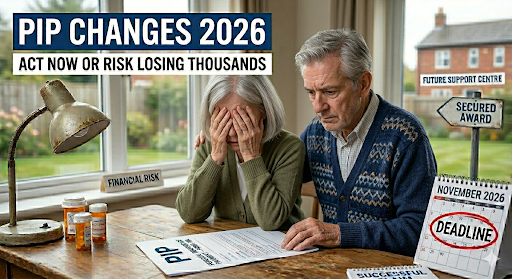
| 📢 Good News — The 4-Point Rule Has Been Delayed On 28 April 2026, the government confirmed that the 4-point rule will not come into force in November 2026 as originally planned. It has been delayed pending a full review of the PIP assessment, led by Minister for Social Security Sir Stephen Timms. The review is expected to conclude by the end of 2026. This is a significant relief for existing claimants — but it does not mean the change has been cancelled. |
Alongside the delay, the government also confirmed on 28 April 2026 that from now on, all new PIP awards will be reviewed no sooner than every three years. If your needs remain the same at that review, the period extends to five years. This is a genuinely positive change — it means less stress and fewer reassessments for people with stable conditions.
What Is PIP and Who Can Claim It?
PIP is a tax-free, non-means-tested benefit for people aged 16 to State Pension age who have a long-term health condition or disability that affects their daily life or mobility. It does not matter how much you earn, how much you have in savings, or whether you work. PIP is assessed entirely on how your condition affects you — not on the diagnosis itself. Understanding who qualifies is the first step to making sense of the PIP changes 2026.
PIP has two components. The Daily Living component helps with the extra costs of everyday tasks such as preparing food, washing, dressing, and managing medication. The Mobility component helps with the extra costs of getting around.
You can receive one or both components, each at either a standard or enhanced rate. The April 2026 rates are:
| Component | Rate | Weekly Amount | Per 4 Weeks |
| Daily Living | Standard | £76.70 | £306.80 |
| Daily Living | Enhanced | £114.60 | £458.40 |
| Mobility | Standard | £30.30 | £121.20 |
| Mobility | Enhanced | £80.00 | £320.00 |
| Both Enhanced | Maximum | £194.60 | £778.40 |
To qualify, you must have had difficulties for at least three months and expect them to continue for at least another nine months. You are assessed by a health professional who awards points based on how your condition affects specific activities. For the official eligibility criteria, see the DWP’s PIP guide on GOV.UK.
One important point for our readers: PIP is available up to State Pension age, which is currently rising from 66 to 67 between April 2026 and 2028. This means some people aged 65 or 66 are still under State Pension age and can make a new PIP claim. If you are already over State Pension age, Attendance Allowance may be the right benefit for you instead — see our guide to unclaimed benefits for pensioners for more details.
The Good News — What Has Been Delayed
The 4-point rule was the change that caused the most alarm among disability organisations, claimants, and their families. It would have meant that people with multiple moderate difficulties — exactly the kind of distributed impact that many conditions like arthritis, COPD, and early-stage dementia cause — could have lost their daily living award entirely.
Here is how it would have worked in practice. Imagine someone who scores 2 points each across four daily living activities, giving them a total of 8 points — just enough for the standard rate. Under the old rules, they qualify. Under the 4-point rule, they would not — because no single activity reaches 4 points.
The Office for Budget Responsibility estimated that more than a quarter of PIP reviews between November 2026 and March 2030 would have resulted in claimants losing their daily living award. That is approximately 430,000 people. Understanding the full scope of the PIP changes 2026 helps you take the right steps now.
| ⚠️ Important: Delayed Does Not Mean Cancelled The 4-point rule has been delayed — not scrapped. The government has confirmed it still intends to reform PIP eligibility following the Timms Review. Opposition from Labour MPs, Disability Rights UK, Scope, and Trussell remains strong. We will update this article as soon as the review concludes. |
What IS Changing Right Now
While the 4-point rule has been delayed, several PIP changes 2026 are already in effect or confirmed. Here is what is actually happening:
PIP Rates Increased in April 2026
All PIP payments increased by 3.8% from 6 April 2026, in line with September 2025 CPI inflation. This happened automatically — you did not need to do anything. If you are already on PIP, you should have received an uprating letter confirming your new amount. If you have not received one, contact the DWP on 0800 121 4433. You can also check the latest rates on the official DWP PIP rates page.
Fewer Reassessments for Stable Conditions
One of the most welcome PIP changes 2026 brings is on reassessments. From April 2026, all new PIP awards will be reviewed no sooner than every three years. If your condition is unchanged at that review, the period extends to five years. Around 700,000 existing claimants with severe, lifelong, or terminal conditions are also exempt from routine reassessments entirely. This is a significant improvement from the previous system of frequent reviews.
More Evidence-Based Assessments
The Timms Review is also examining how assessments are carried out. The direction of travel is towards greater use of medical evidence from GPs and specialists, and fewer face-to-face assessments. This has been widely welcomed by disability organisations.
Should You Claim PIP Before the Rules Change?
If you are under State Pension age, have a long-term health condition or disability, and are not currently claiming PIP — the honest answer is: yes, you should consider claiming now, under the current more generous rules. With the PIP changes 2026 still evolving, acting sooner gives you more protection.
The conditions most likely to qualify include arthritis, back pain, COPD, heart conditions, diabetes with complications, depression and anxiety, early-stage dementia, Parkinson’s disease, and many others. You do not need a formal diagnosis to claim — you need to show how your condition affects your daily life. For free, impartial guidance, Citizens Advice has an excellent step-by-step PIP help guide.
Here is how to start:
- Call the DWP PIP new claims line on 0800 917 2222 (Monday to Friday, 8am to 6pm). This call starts your claim and records your start date — do not download the form instead, as payments only begin from when the DWP receives the form, not from when you called.
- You will be sent a PIP2 form asking about how your condition affects you. Take your time with this — describe your worst days, not your best.
- Get free help completing the form from Citizens Advice or Age UK. Their advisers know exactly how to present your needs effectively.
- You will usually be invited to a telephone or face-to-face assessment with a health professional.
- A decision is made and you will receive a letter. If you are turned down or awarded a lower rate than expected, you can request a Mandatory Reconsideration.
| 💡 Tip: Describe Your Worst Days PIP is assessed on how your condition affects you on your worst days — not your average days and certainly not your best days. Be honest and detailed. If a task causes pain, fatigue, or takes much longer than it would for someone without your condition, say so. Many claims are initially refused because people understate their difficulties. |
What If You Are Already Claiming PIP?
If you are already receiving PIP, the immediate position is reassuring. Your current award continues unchanged until your next scheduled review. As part of the PIP changes 2026, the 4-point rule does not apply to you yet — and may never apply if the Timms Review recommends a different approach.
There are a few things worth knowing:
- If your condition has worsened since your last assessment, you can request a review separately — do not wait for your scheduled review date. Contact the DWP to report a change in your condition.
- If you are over State Pension age and already receiving PIP, your payments continue. The DWP will usually give you an indefinite award, reviewed every ten years rather than every three to five.
- If you lose your PIP award at a future review because of the new eligibility rules, you will receive a 13-week run-on payment to give you time to adjust.
- If you disagree with any decision about your PIP, always request a Mandatory Reconsideration first, then appeal to a tribunal if needed. Success rates at tribunal are high — around 60% of appeals succeed. Our guide to your legal rights as a pensioner covers how to challenge benefit decisions in full.
Your PIP Questions Answered
Q: Will I lose my PIP because of the 2026 changes?
Not automatically. Existing claimants keep their award until their next scheduled review. The PIP changes 2026 4-point rule has been delayed until after a government review expected to conclude by end of 2026, and may be amended or scrapped entirely. Your payments are safe for now.
Q: Can I claim PIP if I am over 65?
It depends on your State Pension age. PIP is available to people under State Pension age, which is currently rising from 66 to 67 between April 2026 and 2028. Check your personal State Pension age at GOV.UK. If you are already over State Pension age, Attendance Allowance is the equivalent benefit — it pays up to £114.60 per week and is also tax-free.
Q: How much is PIP in 2026?
From April 2026, the daily living component pays £76.70 (standard) or £114.60 (enhanced) per week. The mobility component pays £30.30 (standard) or £80.00 (enhanced) per week. The maximum combined award is £194.60 per week, or £10,119 per year.
Q: What is the 4-point rule?
The 4-point rule was a proposed change to PIP changes 2026 eligibility that would have required claimants to score at least 4 points in a single daily living activity, in addition to the existing 8-point total. It has been delayed pending a government review. No date has been set for when or whether it will be introduced.
Key Takeaways
- The most feared PIP changes 2026 proposal — the 4-point rule — has been delayed and will not take effect until after a government review expected by end of 2026
- PIP rates increased by 3.8% in April 2026 — the maximum award is now £194.60 per week or £10,119 per year
- All new PIP awards will now be reviewed no sooner than every three years — less stress and fewer reassessments
- If you are under State Pension age with a health condition and not claiming PIP, apply now under the current more generous rules
- Existing claimants are protected until their next review — and the 4-point rule may yet be amended or scrapped
- If you are over State Pension age, Attendance Allowance may be the right route instead
- Any rule changes must pass Parliament — opposition from MPs and disability organisations remains strong
Action Checklist
- Check your State Pension age at GOV.UK
- If under State Pension age with a health condition — call DWP on 0800 917 2222 to start a PIP claim
- Get free help completing your PIP form from Citizens Advice or Age UK
- If already on PIP — check your uprating letter confirms your new April 2026 payment amount
- If your condition has worsened — request a review now, do not wait for your scheduled date
- Bookmark this article — we will update it as the Timms Review progresses
Related Articles on Honest Pensioner
- Care Home Costs 2026: What You Need to Know
- Pension Inheritance Tax 2027: What Changes Are Coming
- Free NHS Health Checks — Who Qualifies and How to Book
- State Pension Age Increase: Everything You Need to Know
| 📋 Disclaimer This article provides general information about PIP changes 2026 and does not constitute financial or legal advice. PIP eligibility depends on your individual circumstances. For personalised guidance, contact Citizens Advice on 0800 144 8848, Age UK on 0800 678 1602, or visit GOV.UK/pip. |
PIP Changes 2026 | Honest Pensioner | Last updated 29 April 2026 | Mark Aucamp