
The winter fuel payment scam has taken a dangerous new turn in 2026. With nearly two million pensioners now receiving official-looking letters, texts and emails about repaying their winter fuel payment, fraudsters have a perfect cover story — and HMRC has already logged over 25,000 scam referrals in the past year alone. The problem is that fake communications can look almost identical to the real thing.
I spent 15 years in consumer finance, and the single most important lesson I took from that time is this: scammers do not invent new tricks, they copy legitimate processes and add pressure. That is exactly what is happening here. The genuine repayment process is real, automatic, and requires no action from most people — but the winter fuel payment scam is exploiting that confusion on a massive scale.
So how do you tell the difference between a genuine HMRC communication and a fake one? Here are the 8 warning signs to look for in any letter, text, email or phone call you receive about your winter fuel payment.
| The One Rule That Overrides Everything HMRC will NEVER send you a text or email asking you to repay your winter fuel payment, or requesting your bank details. If any message asks you to click a link, call a number, or provide financial information — it is a scam. Full stop. For most people, repayment happens automatically through a PAYE tax code change from April 2026. No action is needed from you. |
Warning Sign 1: The Message Contains a Clickable Link
This is the single clearest indicator that something is wrong. Genuine HMRC texts and emails about winter fuel payment repayment do not contain links. The real message will tell you that your tax code has changed — and nothing more. It will not ask you to click through to verify, confirm, or complete anything.
Scammers include links because they need you to visit a fake website — often a convincing clone of GOV.UK — where they can harvest your personal details, bank account information, or National Insurance number. The moment you see a link in a message about your winter fuel payment, you are almost certainly looking at a winter fuel payment scam.
What to do: Do not click. Forward suspicious texts to 60599 and suspicious emails to phishing@hmrc.gov.uk.
Warning Sign 2: It Asks for Your Bank Details
HMRC already holds payment information for pensioners receiving State Pension or DWP payments. They do not need to ask for it again. Any communication — letter, text, email or phone call — that requests your bank account number, sort code, or card details is fraudulent, without exception.
This applies even if the message says it needs your bank details to process a refund or to avoid a fine. Both are scam tactics. HMRC will never ask for payment information through an unsolicited contact.
What to do: End the call or delete the message immediately. If you have already provided bank details, call your bank straight away using the number on the back of your card.
Warning Sign 3: It Creates Urgency or Threatens Consequences
Urgency is a scammer’s most powerful weapon. Phrases like “you must act within 24 hours”, “your account will be suspended”, “a warrant has been issued” or “you face prosecution” are designed to make you panic and act without thinking.
The real HMRC repayment process has no urgency for most people. If you are on PAYE, your tax code is adjusted automatically — you do not need to do anything, and there is no deadline for you to meet. There are no fines for failing to respond to a letter about your tax code change.
What to do: Stop, breathe, and do nothing the message demands. Go directly to gov.uk/guidance/paying-back-the-winter-fuel-payment and check your status there yourself.
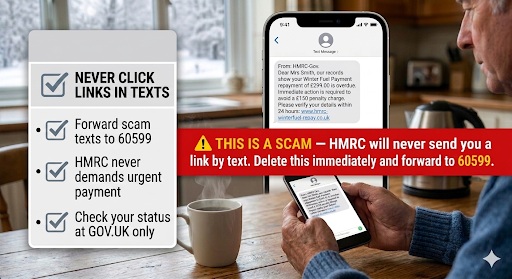
| The 8 Warning Signs at a Glance 1. The message contains a clickable link 2. It asks for your bank details 3. It creates urgency or threatens consequences 4. It asks you to call a number provided in the message 5. The web address is not exactly gov.uk 6. It promises a refund or unexpected payment 7. It arrives by a method HMRC would not use 8. It requests payment by gift card, bank transfer or cryptocurrency |
Warning Sign 4: It Asks You to Call a Number in the Message
A common tactic is to provide a phone number in a letter or text and ask you to call it to resolve your winter fuel payment situation. The number connects to scammers posing as HMRC staff, who then attempt to extract personal information or payment from you.
The genuine HMRC winter fuel payment helpline is 0800 731 0160 — but you should only ever use a number you have found yourself on GOV.UK, not one provided in any message you have received unsolicited.
What to do: Never call a number given to you in an unsolicited message. Go to GOV.UK and find the correct contact details yourself.
Warning Sign 5: The Web Address Is Not Exactly gov.uk
One of the cleverest winter fuel payment scam tactics is creating fake websites that look identical to the official government site. But the web address always gives them away if you look carefully. The official site is always and only www.gov.uk — nothing before it, nothing after it.
Fake addresses to watch out for include: gov.uk.refund-centre.com, hmrc-gov.uk, gov-uk.info, or ukgov.helpdesk.net. These look plausible at a glance but are fraudulent. Even one extra word or character in the address means the site is fake.
What to do: Always type www.gov.uk directly into your browser yourself. Never follow a link from a text or email to get there.
Warning Sign 6: It Promises a Refund or Unexpected Payment
Not all winter fuel payment scams demand money — some offer it. You may receive a message claiming HMRC owes you a refund, that you have been overpaid and are due money back, or that you qualify for an additional payment. This feels positive and lowers your guard.
HMRC does not contact people out of the blue to offer refunds by text or email. If you are genuinely owed a tax refund, HMRC will write to you by post, and the process does not involve providing bank details online through a link.
What to do: If you think you might genuinely be owed money, log in to your personal tax account directly at www.gov.uk/personal-tax-account — do not respond to the message.
Warning Sign 7: It Arrives by a Method HMRC Would Not Use for This
Knowing how HMRC actually communicates about winter fuel payment repayment helps you spot anything outside that pattern.
How HMRC genuinely contacts you about this:
- By post — a letter confirming your tax code has changed, requiring no action from you
- By text or email — only to notify you of a code change, with no links and no requests for information
- Via your personal tax account at GOV.UK — which you access yourself, never through a link in a message
HMRC will not contact you about this via WhatsApp, social media, emails with attachments to open, or voicemails threatening immediate legal action. If the contact method does not match the above, treat it with serious suspicion.
Warning Sign 8: It Requests Payment by Gift Card, Bank Transfer or Cryptocurrency
This is the most unmistakable sign of a scam. If any communication — however official it looks — asks you to pay using iTunes gift cards, Amazon vouchers, a bank transfer to a new account, or cryptocurrency, it is fraud. HMRC does not accept payment by any of these methods, ever.
These payment methods are largely untraceable and irreversible. Once money leaves your account this way, recovery is extremely difficult. That is precisely why every winter fuel payment scam operator insists on them.
What to do: If you have already made a payment this way, contact your bank immediately, then report to Action Fraud on 0300 123 2040. In Scotland, contact Police Scotland on 101.
| What the Real Repayment Process Looks Like Income above £35,000 (PAYE): HMRC adjusts your tax code automatically from April 2026. A £200 payment is recovered at around £17/month over the tax year. You receive a notification — no action needed. Self Assessment (online): Pre-populated in your 2025/26 return, due 31 January 2027. Self Assessment (paper): You must add it manually. Deadline: 31 October 2026. Check your status: www.gov.uk/guidance/paying-back-the-winter-fuel-payment — no need to call HMRC. |
What to Do If You Think You Have Received a Scam Message
Follow these steps in order:
- Do not click any links, call any numbers, or provide any information in response to the message
- Suspicious text: forward to 60599
- Suspicious email: forward to phishing@hmrc.gov.uk
- Suspicious call: report at gov.uk/report-suspicious-emails-websites-phishing
- If you have given money or bank details: call your bank immediately, then report to Action Fraud on 0300 123 2040
- Verify your actual status at gov.uk/guidance/paying-back-the-winter-fuel-payment
Related Reading on Honest Pensioner
- 6 Pension Scams Targeting Pensioners Right Now — the wider picture of pension fraud in 2026
- Phone Scams Targeting Older People — how to protect yourself from fraudulent calls
- Making a Will in Retirement — protecting your estate and your family
Frequently Asked Questions
How do I know if an HMRC letter about winter fuel payment is real?
A genuine HMRC letter will simply confirm your tax code has been changed for 2026/27. It will not ask you to take any action, call a number, visit a website, or provide personal information. If the letter asks for any of those things, it is almost certainly a winter fuel payment scam — verify your status directly at GOV.UK before doing anything.
I received a text from HMRC with a link — is it a scam?
Almost certainly yes. Genuine HMRC texts about winter fuel repayment do not include links. This is one of the most reliable ways to identify a winter fuel payment scam. Do not click it. Forward the text to 60599 and delete it.
What if I have already clicked a link or given my details?
Act immediately. If you provided bank details, call your bank using the number on the back of your card and ask them to protect your account. Then report to Action Fraud on 0300 123 2040. If you only clicked a link but entered nothing, run a security scan on your device and change your banking and email passwords.
Can I opt out of receiving the winter fuel payment to avoid the confusion?
Yes. If your income is above £35,000 and you know you will need to repay it anyway, call 0800 731 0160 or complete the opt-out form at GOV.UK. You only need to do this once.
The Bottom Line
The winter fuel payment scam is thriving because the repayment process is new, complex, and touching nearly two million people at once. Scammers have a ready-made excuse to make contact — and they are making the most of it.
The warning signs are consistent and learnable. A link in a message, a request for bank details, artificial urgency, or a non-standard payment method — any one of these should make you stop immediately and verify through GOV.UK directly.
Share this article with anyone who might be at risk. Awareness is the single best defence against a winter fuel payment scam — and a two-minute conversation could save someone real money.
For more scam warnings, visit the Scams & Fraud section of Honest Pensioner.
Sources
- GOV.UK — Pensioners urged to be alert to Winter Fuel Payment scams (April 2026)
- GOV.UK — Paying back the Winter Fuel Payment
- MoneySavingExpert — Winter Fuel Payment clawback and scam guide (2026)
- MoneyHelper — Scams warning: Winter Fuel Payment
- Action Fraud — Report fraud
- ICAEW — Over 25,000 winter fuel payment scam referrals (April 2026)