Common law partner rights after death UK are almost non-existent — and that is something millions of older couples simply do not know or understand. Margaret and Brian had been together for 25 years. They shared a home, pooled their money, and assumed they would be looked after if the worst happened. When Brian died suddenly at 71, Margaret discovered the devastating truth: because they had never married, the law treated her as little more than a stranger to his estate.
She could not automatically stay in the home they shared. She was not recognised as next of kin. She could not inherit Brian’s pension. And unlike a married spouse, she faced a potential Inheritance Tax bill on anything left to her in Brian’s will. Margaret’s story is not unusual — it plays out across the UK every year, and the reason is almost always the same: the widespread belief in something called ‘common law marriage’ — a concept that sounds legal, feels real, and simply does not exist.
| 📊 KEY FACT |
| More than 46% of adults in England and Wales mistakenly believe that living together gives the same legal rights as marriage. |
| There are an estimated 3.6 million cohabiting couples in the UK — the fastest-growing family type in the country. |
| Yet UK law offers cohabiting partners almost no automatic financial protection when a partner dies. |
This guide explains common law partner rights after death in the UK in plain English — what you are and are not entitled to, where the law falls short, and the practical steps you can take right now to protect yourself and the person you love.
What Is ‘Common Law Marriage’ — and Why Doesn’t It Exist?
The phrase ‘common law husband’ or ‘common law wife’ is used freely in everyday conversation. Many people believe that after living together for a certain number of years — five, ten, twenty — you automatically acquire legal rights similar to a married couple. This belief is understandable. It is also completely wrong.
There is no such thing as common law marriage in England or Wales. Citizens Advice confirms that cohabiting couples have significantly fewer legal rights than married couples, regardless of how long they have lived together. Scotland has slightly different property rules, but even there, cohabitation does not create the same rights as marriage.
The length of your relationship makes absolutely no difference to your legal standing. You could have lived together for 30 years, raised children together, and jointly owned a home — and the law would still not treat you as a spouse.
| ⚠️ WARNING |
| Living together for any length of time does NOT give you the same rights as a married couple. |
| There is no legal definition of ‘common law husband’ or ‘common law wife’ in UK law. |
| The only way to gain automatic spousal rights is through marriage or a civil partnership. |
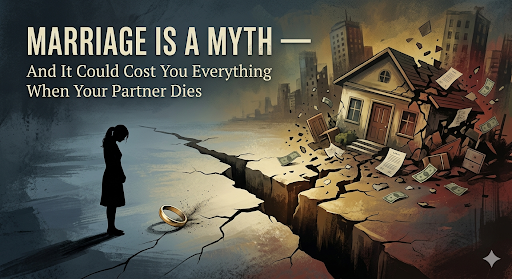
Common Law Partner Rights After Death UK — The Honest Reality
When a married person dies, their spouse is protected automatically — through inheritance rights, pension entitlements, bereavement benefits, and tax exemptions. As an unmarried partner, you receive almost none of this by default. Here is what actually happens:
1. Inheritance — You May Receive Nothing
If your partner dies without a will, their estate is distributed under the rules of intestacy. These rules do not recognise unmarried partners. At all. The estate passes to children first, then parents, then siblings — in that order. You, as a long-term partner, are not in the queue.
Even if your partner left a will naming you as a beneficiary, anything you inherit is potentially subject to Inheritance Tax at 40% above the nil-rate band (currently £325,000) — a bill a married spouse would never face on money inherited from their partner.
| ⚠️ WARNING |
| No will = no inheritance. Intestacy rules ignore unmarried partners entirely. |
| Any inheritance you do receive may be taxed at 40% above £325,000. |
| Married spouses pay zero Inheritance Tax on assets passed between them. |
2. The Family Home — You Could Be Asked to Leave
If the property is in your partner’s sole name and they die without a will, you have no automatic right to remain in it. The executors of the estate may be legally required to ask you to leave so the property can pass to the next of kin.
If you own the property as joint tenants, their share passes automatically to you on death. But if you own as tenants in common, their share goes to their estate — not to you. Many couples are surprised to discover which arrangement applies to them. A solicitor can check this quickly using the title register at HM Land Registry.
3. State Pension — You Cannot Inherit It
A married person or civil partner may be able to inherit a portion of their late spouse’s State Pension, depending on when they both reached State Pension age. An unmarried partner cannot — under any circumstances. GOV.UK confirms that only spouses and civil partners can inherit State Pension entitlements. For a full guide to how pension inheritance works, see our article What Happens to Your Partner’s Pension When They Die?.
4. Bereavement Support Payment — Almost Certainly Not Available to You
Bereavement Support Payment (BSP) is a government benefit for bereaved partners, comprising a tax-free lump sum of up to £3,500 and up to 18 monthly payments of £350. To qualify, you must have been married or in a civil partnership with the deceased.
A 2023 rule change extended eligibility to cohabiting partners with dependent children. But for most couples over 55 — whose children have grown up — this exception will not apply. You can check your eligibility using the Bereavement Support Payment guide on GOV.UK.
5. Pension Death Benefits — Only If You Are Named
Workplace and private pensions allow members to nominate who should receive death benefits. These nominations — called Expression of Wish forms — are not legally binding (the trustees decide), but they carry significant weight. If your partner never updated their form, the death benefits could go to an ex-spouse, a child, or their estate.
| ✅ TIP |
| Check your own and your partner’s Expression of Wish forms with every pension provider. Use the government’s Pension Tracing Service to track down any old workplace pensions. |
| For more detail on how pension nominations work, see our guide How to Make Sure Your Pension Goes to the Right Person. |
Married vs. Unmarried: A Side-by-Side Comparison
The table below shows how the law treats married couples versus cohabiting partners when one partner dies:
| Situation | Married / Civil Partner | Cohabiting (Unmarried) |
| Inherit estate with no will | ✅ Yes — automatic | ❌ No — nothing automatically |
| Stay in shared home | ✅ Yes — strong rights | ❌ No — can face eviction |
| Inherit State Pension | ✅ Yes (some entitlement) | ❌ No — not eligible |
| Bereavement Support Payment | ✅ Yes (if under State Pension age) | ❌ No (unless children) |
| Inheritance Tax exemption | ✅ Yes — transfers tax-free | ❌ No — IHT may apply |
| Next of kin status | ✅ Automatic | ❌ Not recognised in law |
| Pension death benefits | ✅ Usually automatic | ⚠️ Only if nominated in writing |
Can You Make a Legal Claim Against Your Partner’s Estate?
There is a legal avenue for cohabiting partners who have been left out: a claim under the Inheritance (Provision for Family and Dependants) Act 1975. This allows certain people to ask the court for ‘reasonable financial provision’ from the deceased’s estate.
To be eligible as an unmarried partner, you must have been living together as a couple in the same household for at least two years immediately before the death. Even then, the process is:
- Expensive — legal costs can run to thousands of pounds
- Time-consuming — cases can take months or years to resolve
- Emotionally draining — you may face opposition from the deceased’s family
- Uncertain — the court has wide discretion over the outcome
| ⚠️ WARNING |
| Any claim under the Inheritance Act 1975 must be made within 6 months of the Grant of Probate. |
| This is a last resort — not a safety net. Prevention is far better than a court battle. |
| Seek advice from a solicitor specialising in contentious probate as soon as possible if you think you may need to make a claim. |
What About the Government’s Plans to Reform Cohabitation Law?
The Labour Government announced in early 2025 that it would begin a formal consultation on cohabitation rights, with proposals to give some automatic protections to couples who have lived together for two years or more. The Law Commission has long recommended reform in this area.
This is encouraging — but as of April 2026, no new law has been passed. Government consultations take years to translate into legislation. You cannot afford to wait. The steps below cost far less than a court case and provide genuine protection right now.
How to Protect Yourself — Six Steps to Take Now
Understanding common law partner rights after death UK is the first step. Acting on that knowledge is the second. Here is what solicitors and financial advisers recommend for every cohabiting couple:
1. Make Wills — Both of You, Today
A legally valid will is the single most powerful thing you can do. It allows your partner to inherit from you exactly as a married spouse would — the only difference being that Inheritance Tax exemptions do not apply between unmarried partners. Without a will, the intestacy rules leave your partner with nothing.
A straightforward will typically costs £150 to £300 through a solicitor. The Law Society’s find-a-solicitor tool can help you find one near you. You can also use Citizens Advice as a free first port of call.
2. Get a Cohabitation Agreement
A cohabitation agreement (also called a living together agreement) is a legally binding document setting out how you own your assets, what happens to your shared home, and what financial arrangements you have agreed on. It can cover anything from property shares to who pays which bills.
Costs typically range from £500 to £1,500 depending on your circumstances. Think of it as insurance against everything the law does not automatically provide. For more on protecting your finances as a couple, see our guide Power of Attorney — Why You Need One Before You Think You Do.
3. Check Your Property Ownership
Find out whether you own your home as joint tenants or tenants in common — these are very different in law. If you are tenants in common, your partner’s share will pass according to their will, or to the intestacy rules if there is no will. You can check your ownership status for free on the HM Land Registry website.
4. Update Pension Nomination Forms
Contact every pension provider — workplace, private, and any old deferred pensions — and make sure your partner is named as your nominated beneficiary. Ask your partner to do the same for you. If you are not sure whether there are old pensions you have lost track of, use the free Pension Tracing Service.
5. Get a Lasting Power of Attorney
A Lasting Power of Attorney (LPA) allows your partner to manage your finances and make healthcare decisions if you become unable to do so yourself — through illness or accident. Without one, your partner has no legal authority to act on your behalf, even to pay bills from a joint account.
You can register an LPA through the Office of the Public Guardian for £82 per LPA. It typically takes 8 to 12 weeks to register, so do not leave it until you need it. Our full guide What Is a Lasting Power of Attorney and Do I Need One? walks you through the process step by step.
6. Review Life Insurance
Check that your life insurance policy names your partner as the beneficiary. If the policy is in your name only and you have no will, the payout may go to your estate rather than directly to your partner — causing delays and potential tax complications. A quick call to your insurer can confirm the current nomination and update it if needed.
Your Protection Checklist
Work through this checklist with your partner:
- Both partners have up-to-date, legally valid wills
- A cohabitation agreement is in place
- Home ownership type confirmed (joint tenants or tenants in common)
- Both partners named on each other’s pension Expression of Wish forms
- Life insurance policies name the correct beneficiary
- Lasting Power of Attorney registered for both partners
- Old pensions located using the Pension Tracing Service
- A family solicitor has reviewed your overall position
Quick Answers — Your Questions on Common Law Partner Rights
| ❓ QUICK ANSWERS — Common Questions |
| Do I have any rights as a common law partner if my partner dies in the UK? |
| Virtually none automatically. Common law partner rights after death in the UK are extremely limited. Without a will, a cohabitation agreement, or joint property ownership, an unmarried partner has almost no legal claim to their partner’s estate, home, pension, or bereavement benefits. |
| How long do you have to live together to have rights in the UK? |
| No length of time creates automatic rights. Even after 30 years, the law does not treat you as a spouse. The only exception is if you have lived together for at least two years, which qualifies you to make a claim under the Inheritance Act 1975 — but this is a court process, not an automatic entitlement. |
| Can an unmarried partner inherit a house in the UK? |
| Only if the property is owned as joint tenants (it passes automatically), or if the deceased left it to them in a valid will. If the property is in the deceased’s sole name with no will, the surviving partner has no automatic right to stay or inherit — and may face eviction. |
| Does a cohabiting partner get a bereavement payment from the government? |
| Only in limited circumstances. Bereavement Support Payment is available to married couples and civil partners. Unmarried cohabiting partners may only claim if they have dependent children. Most older couples — whose children have grown up — will not qualify. |
Final Thoughts From the Honest Pensioner
Common law partner rights after death in the UK are a shock to most people who discover them — usually at the worst possible moment. The good news is that with a little planning, you can close most of the legal gaps that marriage would otherwise fill. A will, a cohabitation agreement, and a few updated nomination forms could make an enormous difference to the person you love.
If you’re thinking about financial protection more broadly, it’s also worth reading our guide to Over 60s Private Health Insurance — particularly if one partner has health concerns that could affect the other’s financial security.
You do not need to get married. You just need to get organised. Start with a conversation — then take action. A good solicitor can help you get everything in order for a few hundred pounds. That is a very small price to pay for the peace of mind of knowing your partner will be protected.
If you are not sure where to start, Citizens Advice offers free, impartial guidance on all of the issues covered in this article.
© Honest Pensioner | honestpensioner.com | For information purposes only — not legal advice. Always consult a qualified solicitor for advice specific to your situation.