

A Story That Should Never Have Happened
Retirement flat problems are more widespread than most people realise — and for thousands of over-55s across England and Wales, they have turned what looked like a dream home into a financial nightmare.
When her mother passed away, Sarah inherited what looked, on paper, like a stroke of good fortune. A retirement flat in a purpose-built development — smart communal areas, an on-site manager, landscaped gardens. Her mother had loved it there. She had felt safe, looked after and part of a community.
What Sarah inherited in reality was something very different.
The flat was hers legally. The title deed had her name on it. She was in her late fifties, willing to pay every penny of the ongoing costs, and ready to move in. But when she contacted the management company to arrange the transfer, she was told she was too young to live there. The development had an age restriction — and she fell just three years short of it.
She could not live there. The lease prevented her from renting it out. No buyer had come forward, despite the property being on the market. And yet the service charges kept running — every single month — on an empty flat she could not use, could not sell and could not let. When payments fell behind, she received letters threatening debt recovery action.
At the time, Sarah was living in a bedsit more than two hours away. She could barely afford her own rent.
“It didn’t make sense,” she said. “I’d inherited it, the title was legally mine, I was willing to pay the fees and I was over 55.” That was not enough.
Sarah’s experience is not a rare or isolated case. It is one of a growing number of stories emerging from across England and Wales — stories of pensioners and their families who discovered, too late, that the retirement flat they bought or inherited had become a financial trap rather than a secure home.
If you are aged 55 or over and considering buying a retirement flat, this guide is written for you. Read it before you sign anything.
What the Brochure Promises — and What Can Happen Instead
The sales pitch for purpose-built retirement flats is genuinely appealing. Low-maintenance living. Security. A community of like-minded people. An on-site manager. Communal lounges, gardens, sometimes a restaurant or a gym. Peace of mind for your family. All in a property designed specifically for the way you want to live in your later years.
For some people, it genuinely works well. There are developments with fair charges, well-managed leases and a healthy resale market. We are not saying all retirement flats are a bad idea.
What we are saying is this: retirement flat problems are real, they are widespread, and they are serious enough that every over-55 must go in with their eyes fully open.
Below, we have set out the 8 most important retirement flat problems to understand before you commit — and for each one, exactly what to ask the developer or managing agent before you sign.
Understanding retirement flat problems before you commit could save you tens of thousands of pounds.

The 8 Retirement Flat Problems You Must Understand
Problem 1: Service Charges That Rise Well Above Inflation
The service charge is the annual fee that covers communal maintenance, on-site staff, gardening, building insurance and shared facilities. On the face of it, reasonable. In practice, one of the most serious retirement flat problems in the sector.
Charges at some developments have risen by 15% or more in a single year. At one development, a resident’s charge rose from £12,000 to £20,000 in just six years — an increase of 66%. Across the sector, average service charges rose by over 40% between 2019 and 2024. On a fixed pension income, a charge that starts manageable can become genuinely unaffordable within just a few years.
Crucially, once you have bought, you have limited power to challenge these increases. The freeholder sets the charge, not the residents. For your rights as a leaseholder, see Citizens Advice — Leasehold Property Rights.
| 🗨 What to ask: Can you provide the full service charge history for this development for each of the past five years? What was the percentage increase each year? And what is your projected increase for next year? |
Problem 2: Properties That Lose Significant Value on Resale
Most people buying a retirement flat expect it to hold its value reasonably well — even if it is not a growth investment. Retirement flat problems with resale values suggest this assumption is often wrong.
Analysis of Land Registry records at one development found that of 27 flats resold over a ten-year period, 24 had fallen in value — losing a combined total of more than £1 million. One flat originally sold for over £200,000 was later resold for £70,000. Another went to auction for £9,000.
Across the sector, investigations have found that properties with the highest service charges have lost the most value — because the very charges that make them expensive to own make them unattractive to future buyers. A property that costs £10,000 a year just to hold is a hard sell.
Always check Land Registry resale prices for the specific block you are considering — not just the developer’s own figures. You can search at HM Land Registry — Search for Property Information.
| 🗨 What to ask: What have properties in this specific development actually resold for over the past five years? Can you provide Land Registry data or ask your solicitor to search this independently? |
Problem 3: Exit Fees That Take a Significant Slice When You Sell
Many retirement flat leases include an exit fee — sometimes called a transfer fee, event fee or departure fee. This is a charge payable to the freeholder when you sell, and in some cases when you sublet or when a new person moves in.
Exit fees typically range from 1% to 2% of the sale price at the lower end, but the Leasehold Knowledge Partnership has found they average around 12% across the sector. On a £200,000 property, 12% means £24,000 gone before you have even paid estate agent fees — on top of any fall in the sale price itself.
Some developers have begun removing exit fees under pressure from MPs and consumer groups. But many have not, and the obligation sits within the lease itself, meaning you are bound by it from the moment you sign.
| 🗨 What to ask: Does the lease include an exit fee, event fee or transfer fee of any kind? If so, what is the exact percentage and under exactly what circumstances does it apply? |
Problem 4: Lease Clauses That Strip Away Your Options
Retirement flat problems are often buried in the lease — a document that can run to many pages and that buyers sometimes do not read carefully enough before committing. Several lease clauses regularly appear that significantly restrict what you can do with your own property.
Common clauses to watch for:
- A ban on subletting — meaning if you move into care or need to move away, you cannot rent the property out to help cover the ongoing charges.
- An obligation to fully redecorate the property at your own expense before you are permitted to sell.
- A clause stating the property cannot be sold for less than market value — which can trap owners who are unable to find a buyer at full price.
- Restrictions on who can visit or stay overnight, which can affect family carers.
Always have the lease reviewed by an independent solicitor who specialises in leasehold property — not one recommended by the developer. The Law Society can help you find a specialist conveyancing solicitor.
| 🗨 What to ask: Can I have a full copy of the lease to share with my own independent solicitor before I make any decision? Are there any restrictions on subletting, decorating before sale or the minimum sale price? |
Problem 5: The Inheritance Trap — Charges That Do Not Stop
This is perhaps the most painful of all retirement flat problems — the one that catches families completely off guard. When an owner moves into a care home or passes away, the service charges do not pause. They continue to run at the full rate, on an empty property, whether or not anyone is living there.
One family paid nearly £900 a month in charges for three years on an empty flat after their mother moved into a care home — and was ultimately forced to sell their own home to keep up. Another family inherited charges that had accrued to over £60,000 by the time a buyer was found. One person described it as a “never-ending nightmare.”
The age restriction clause adds another layer. As Sarah’s story shows, the person who inherits a retirement flat may be too young to live in it — meaning they cannot use it, may not be able to let it, and may struggle to sell it, while charges continue to mount.
Experts estimate there may be as many as 10,000 long-term empty retirement properties across England and Wales — the majority held by families in exactly this position.
One option some families use to protect against ongoing service charges after a loved one passes away is a whole of life policy. Our guide to life insurance over 55 explains the options honestly and what to watch out for.
| 🗨 What to ask: What happens to service charges if the property becomes empty? Are they reduced, suspended or charged at the full rate? And what is the minimum age to purchase or occupy — for both a buyer and an inheriting family member? |
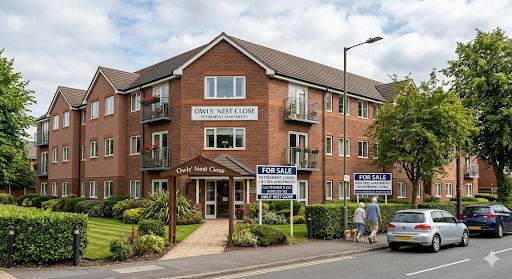
Retirement flat problems have become so widespread that in some developments, a third of all properties sit empty and unsellable at the same time.
Problem 6: Double Council Tax on Inherited or Vacant Properties
Since April 2024, local councils in England have had the power to charge a 100% council tax premium on uninhabited properties. Families who inherit a retirement flat and are unable to sell it are increasingly being caught by this measure — classified as second home owners despite never having chosen to own the property.
One reader was charged over £3,500 in additional council tax on her late mother’s retirement flat, on top of nearly £4,000 in annual service charges and ground rent — all while the property sat unsold and unlived in.
If you are caught in this situation, it is worth contacting your council to seek a discretionary exemption, and checking your rights at GOV.UK — Council Tax Discounts and Exemptions.
| 🗨 What to ask: If the property becomes vacant for any reason — whether I am in hospital, in a care home, or have passed away — what is the council tax position, and has the local authority applied a vacancy premium to properties in this development before? |
Problem 7: Mortgage Restrictions That Shrink Your Future Buyer Pool
Most mainstream lenders will not offer mortgages on retirement properties. This means that when the time comes for you to sell, your potential buyers are limited to people who can purchase with cash — a much smaller pool than the open market.
This is one of the structural retirement flat problems that affects resale values independently of anything else. Even a well-run development with reasonable charges will have a restricted buyer pool simply because of the financing limitations.
The age restriction compounds this further. If the minimum age to purchase is 65 or 70, the number of eligible cash buyers is very small indeed. This is a key reason why some retirement flats sit on the market for a year or more with no serious offer.
| 🗨 What to ask: Are there any lenders currently offering mortgages on properties in this development? What proportion of previous resale buyers purchased with cash versus a mortgage? |
Problem 8: New Developments Competing Directly with Your Resale
One of the less obvious retirement flat problems is the behaviour of developers themselves. A new development in the same town — or even the same street — immediately undercuts any resale in the same area. New-build properties always carry a premium over second-hand ones, and buyers who have a choice will generally choose new.
In one particularly stark case, a developer was actively building a new retirement scheme just 400 metres from an existing block where a third of all properties were simultaneously vacant and on the market. The new development made it even harder for existing owners to sell.
Before you buy, it is worth checking whether the developer has any planning permissions or new schemes under construction nearby. Your solicitor can check local planning records, or you can search yourself at Planning Portal u2014 Find Planning Applications.
| 🗨 What to ask: Does your company have any other developments planned or under construction within five miles of this one? What is your policy on managing the impact on resale values for existing owners? |
Each of these alternatives avoids the most serious retirement flat problems entirely.
The Honest Pensioner Buy-or-Don’t-Buy Checklist
Use this checklist to assess any retirement flat you are considering. For each factor, mark whether the development falls into the Green, Amber or Red column. Be honest with yourself — your financial security depends on it.
The Honest Pensioner Retirement Flat Problems Checklist — Buy or Don’t Buy
| ✅ Green — Reassuring | ⚠️ Amber — Caution | ❌ Red — Walk Away |
| ✅ Service charges under £5,000/year with a clear 5-year history of modest increases | ⚠️ Charges between £5,000–8,000/year with some significant rises in recent years | ❌ Charges above £8,000/year or evidence of rises above 15% in a single year |
| ✅ Developer provides full 5-year charge history upfront without being asked | ⚠️ History available but only on request, or incomplete | ❌ Developer refuses or is unable to provide a clear service charge history |
| ✅ No exit fee, or exit fee of 1% or less clearly stated in the lease | ⚠️ Exit fee between 1–5% — factor into your total cost calculation | ❌ Exit fee above 5% or described vaguely in the lease documents |
| ✅ Subletting is permitted if the property becomes vacant | ⚠️ Subletting permitted only in limited circumstances | ❌ Subletting is banned outright by the lease |
| ✅ Age restriction is 55+ only — broadly matching your family’s ages | ⚠️ Age restriction is 60+ or 65+ — some family members may be excluded | ❌ Age restriction is 70+ or higher — inheritance could become a serious problem |
| ✅ Resale prices in the same block have held steady or risen over 5+ years | ⚠️ Some resales show a modest fall, but the majority have held value | ❌ Multiple resales in the block have fallen significantly in value |
| ✅ Mortgage financing is available from mainstream lenders | ⚠️ Specialist lenders only — limits future buyer pool | ❌ Cash purchase only — severely restricts who can buy from you later |
| ✅ Development is not oversupplied — few or no other flats on the market in the same block | ⚠️ A handful of other flats for sale in the same development | ❌ Multiple properties simultaneously for sale or long-term empty in the same block |
| ✅ Mostly Green — Proceed carefully This development shows the signs of a well-run scheme with a fair lease. You may wish to proceed, but only after independent legal advice, a thorough review of the full lease, and your own Land Registry check on resale prices. Never rely solely on what the developer tells you. |
| ⚠️ Mostly Amber — Look at alternatives first There are enough warning signs here to give you pause. Before committing, explore the alternatives listed below. You may find a better option that gives you the community and security you are looking for without the retirement flat problems this development carries. |
| ❌ Mostly Red — Walk away The risks here are significant. Walking away is not a failure — it is wisdom. There are other ways to achieve the lifestyle you want in retirement without locking yourself into a contract that could cause you or your family serious financial harm. |
If the Answer Is Amber or Red — What to Consider Instead
There are genuine alternatives worth exploring before committing to a retirement flat purchase:
- Sheltered housing (social sector): Council or housing association sheltered schemes offer similar community living with far greater protection over service charges and much better resale flexibility. Waiting lists can be long, but the financial protection is significantly stronger.
- Downsizing to a standard property: A smaller house, bungalow or standard leasehold flat in the open market gives you full resale flexibility, no age restrictions, mainstream mortgage availability for future buyers, and no exit fees. You can still choose a community-oriented development without the retirement-specific lease problems.
- Retirement villages with commonhold ownership: A small number of newer developments are moving toward commonhold ownership rather than leasehold. This gives residents much greater control over service charges and removes exit fees entirely. Worth asking about specifically.
- Equity release on your current home: If your main motivation is releasing capital, equity release may achieve the same result without a move. For impartial guidance, see MoneyHelper — Equity Release.
- Age UK housing advice: Age UK offers free, impartial guidance on all housing options in later life — including sheltered housing, care villages and supported living alternatives.
You Might Also Find These Helpful
For more guidance on protecting your finances and planning securely for later life, read our guides on pension scams targeting pensioners right now, making a will in retirement, and setting up power of attorney — one of the most important steps any over-55 can take.
Your Questions Answered
| Q: Can I challenge a service charge increase on a retirement flat? A: You can apply to the First-tier Tribunal (Property Chamber) to challenge charges you believe are unreasonable. However, this is a formal legal process that takes time and money. It is far easier to check the track record before you buy than to challenge charges once you are committed. |
| Q: What happens to a retirement flat when the owner moves into a care home? A: Service charges continue at the full rate whether or not anyone is living in the property. If the lease prevents subletting, there is no way to offset these costs. This is why checking the service charge vacancy policy before buying is so important. |
| Q: Are retirement flat problems being addressed by the government? A: Partially. The Leasehold and Freehold Reform Act 2024 improved transparency rights for leaseholders, but specifically exempted retirement properties from the ban on leasehold house sales. Some developers have voluntarily removed exit fees, but sector-wide reform of service charge protections for retirement flat owners is still limited. |
| Q: Is there a way to find out the resale history of a specific development? A: Yes. Ask your solicitor to check the Land Registry title register for the block, which records the price paid on every registered sale. This gives you an independent picture of what properties in that specific building have actually sold for over time — not what the developer says they have sold for. |
The Bottom Line
Retirement flat problems are real, they are serious and they are affecting thousands of people across the UK right now. But they are not inevitable. With the right information, the right questions and the right independent advice, you can make a genuinely informed decision — one that protects not just you, but your family long after you are gone.
A retirement flat can be a wonderful place to spend your later years. Just make sure the one you choose deserves your trust, your money and your signature — because once you have signed, your options narrow considerably.
If adapting your current home is a more attractive option, our honest guide to buying a stairlift could save you thousands — including three ways most people overpay.
If this guide has been useful, please share it with anyone you know who is considering a retirement flat purchase. A few minutes reading now could save someone you care about a very great deal of heartache later.
Sources: BBC News, HomeOwners Alliance, HM Land Registry, Citizens Advice, MoneyHelper, GOV.UK, Age UK, The Leasehold Knowledge Partnership, The Telegraph, Inside Housing. This article is for information only and does not constitute financial or legal advice. Always seek independent professional advice before making any property decision.