
Sitting across the table from a client during a fact find, I’d often hear the same thing — ‘I want to buy the big four-bedroom at the end of my road.’ My next question was always the same: who’s giving you this advice?
And almost without fail, I’d hear the dreaded words. ‘My brother bought a buy-to-let last month.’ Or ‘Jack, my mate, has one and he’s doing really well.’
My response was always the same — are your financial circumstances identical? Does your brother have three children to support, like you do? And Jack? Turns out Jack lives on his Jack Jones, divorced, no children, completely different outgoings.
Different horses for different courses. And that’s exactly where most people go wrong before they’ve even started comparing buy to let areas.
After more than 15 years as a mortgage broker, I sat across the table from hundreds of clients who wanted to invest in property for their retirement. What I learned about the best buy to let areas — and the properties within them — might surprise you.
In this guide, I’ll share the five secretsI wish every client had known before they started searching
Table of Contents
Secret 1: Income or Appreciation — Know Which One You Actually Need
Before you even begin searching for the right location, you need to answer one question honestly: are you looking for income now, or wealth over the next 20 years?
There are essentially two types of buy-to-let property. The first rents all day long. It’s the three-bedroom terrace in a busy, practical location — near a hospital, a university, an airport. Solid, steady demand, low empty periods, reliable monthly income. Capital appreciation will be modest, but that’s not the point.
The second is the aspirational property. The four-bedroom semi in the nice suburb. It might grow in value beautifully over two decades, but the yield is lower, the tenant pool is thinner, and a month without a tenant hurts far more.
For retirement investors, the question is almost always the same: do you need income now, or can you wait? If the honest answer is income now — and for most of my clients it was — then the practical, high-demand locations are your focus, not the desirable postcodes.
It is also worth thinking carefully about how you finance the purchase. If you are considering releasing equity from your home to fund a buy-to-let deposit, our guide to remortgaging in retirement covers exactly what lenders look for and how to make your application as strong as possible.
Secret 2: Your Budget Dictates Your Strategy — Not Your Ambition
Here’s what I discovered time and again during a fact find. A client would come in wanting to buy the big four-bedroom at the entrance to their road. Full of enthusiasm. Completely convinced.
Then we’d look at the numbers. Not enough equity in their existing home to raise a decent deposit. Mortgage affordability stretched. And critically — could they survive three months without a tenant? For most, the answer was no.
The buy to let areas you target, and the property type within them, must be driven by what you can genuinely afford — not what your neighbour Jack managed. Your budget isn’t a limitation; it’s your strategy. Work with it, not against it.
A smaller property in the right location, bought within your means, will outperform an overextended dream purchase every single time.
If you are over 55 and unsure whether you can qualify for a buy-to-let mortgage, our article on mortgages after 55 explains the genuine options still available to you, including lenders who take rental income and pension income into account.
If you need a buy-to let property for your rental property, then be sure to compare buy to let mortgages through recommended website and always compare different sites as they have different mortgages available.
Secret 3: Why a Three-Bed Terrace Beats the Four-Bed Dream
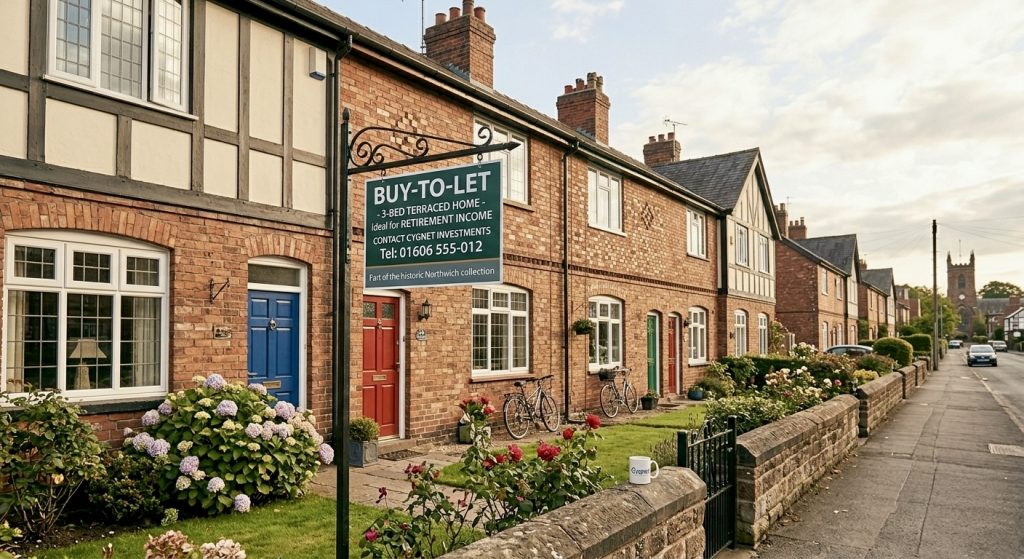
My standard advice to clients who had the right finances in place was always the same: buy a three-bedroom terrace in the right location. Not glamorous. Not impressive at a dinner party. But highly effective as a retirement income vehicle.
Here’s why it works so well. The three-bed terrace sits in a sweet spot of affordability, demand, and flexibility. It attracts working professionals, small families, and key workers — all reliable tenant profiles. empty periods are shorter because demand is broader.
The other advantage is one that most property investment guides never mention: a three-bed terrace can be converted into two self-contained flats. Add a bathroom downstairs and a kitchen upstairs, and you have two one-bedroom apartments, each with their own entrance.
Why does that matter? Because you now have two income streams from one investment — and you are never fully empty. While you are finding a new tenant for one flat, the other is still paying. For a retirement investor relying on monthly income, that protection is invaluable.
Always check permitted development rights and your local council’s HMO licensing rules before converting. Requirements vary significantly across England and Wales, and you will need the correct mortgage product for an HMO property. Your letting agent and a specialist mortgage broker should both be consulted before you proceed.
Secret 4: The Four Best Buy to Let Areas for Stable Tenants and Low Empty Periods
Location is everything in property investment — but not in the way most people think. You are not looking for the most desirable postcode. You are looking for the most reliable demand. These four types of location deliver exactly that.
Near Hospitals
NHS staff, nurses, junior doctors on rotation, healthcare assistants — hospital catchment areas generate consistent, year-round demand from professional tenants. Shift patterns mean they want practical, well-located homes close to work. Empty periods are typically low because the tenant pool is large and constantly replenished. Major hospital clusters around Birmingham, Leeds, Manchester, and London all sit within some of the strongest buy to let areas in the UK.
Near Universities
University towns and cities are among the most reliable locations when you compare buy-to-let mortgages and weigh up rental demand. Student demand is predictable — the academic year creates a natural letting cycle — and the tenant pool is enormous. Academics and postgraduate researchers add a more permanent layer of demand on top. Cities like Manchester, Leeds, Sheffield, and Nottingham offer particularly strong university rental markets for retirement investors.
Near Airports
Cabin crew, ground staff, logistics workers, and aviation engineers all need accommodation close to their workplace. Airport corridors — think areas around Manchester, Birmingham, and Heathrow — attract shift workers who want functional, accessible homes rather than prestige addresses. These are often overlooked locations that offer excellent yield relative to purchase price, particularly for investors working within a defined budget.
Docklands and Regeneration Areas
Former dockland areas have transformed some of Britain’s most compelling opportunities for retirement landlords. Salford Quays, Liverpool Waterfront, and Bristol Harbourside are prime examples — areas where regeneration has driven employment growth, infrastructure investment, and sustained rental demand. Entry prices are often more accessible than established city centres, making them particularly suited to the retirement investor who wants strong yield without overextending their finances.
What unites all four of these locations is a simple truth: people need to live near where they work. That need does not disappear in a housing downturn. It does not evaporate when interest rates rise. Demand driven by employment is the most durable foundation you can build a retirement income strategy on.

Secret 5: Never Be Fully Empty— Protecting Your Retirement Finances
The single biggest fear for any retirement landlord is the empty period. A month without rent when you are relying on that income to supplement your pension is not just inconvenient — it can be genuinely damaging.
The conversion strategy outlined in Secret 3 is the most effective protection. Two self-contained flats mean two separate letting cycles. When one tenant leaves, the other stays. Your income does not stop — it halves temporarily while you find a replacement. That is a manageable situation rather than a financial crisis.
Beyond the conversion approach, choosing the right locations dramatically reduces empty risk. The four location types above — hospitals, universities, airports, docklands — all share one characteristic: they generate demand that does not depend on the general housing market. People will always need to live near where they work.
One final consideration for retirement investors specifically: management. If you are relying on this rental income and you do not want the headache of day-to-day landlord responsibilities, factor in a good letting agent from the start. The proximity of a reliable, regulated letting agent to your property matters almost as much as the location itself.
The costs of a property management service — typically eight to twelve per cent of monthly rent — are worth factoring into your yield calculations from the outset. A well-managed property in one of these locations, with a professional agent handling tenant sourcing and maintenance, is a genuinely passive income stream. That is exactly what retirement investing should look like.
If you are also thinking about the wider picture of property costs in later life, including what happens to your home if you ever need residential care, our article on care home fees is worth reading alongside this one.
Whether you are a first-time landlord or adding to an existing portfolio, the fundamentals remain the same. Location, location, location, property type, and financial planning are the three pillars every successful retirement landlord builds on.

Useful Resources
HMO licensing requirements: GOV.UK — Houses in Multiple Occupation
Find a regulated letting agent: Propertymark — Find an Agent
Frequently Asked Questions
What is meant by buy-to-let?
Buy-to-let refers to a property purchased specifically to rent out to tenants rather than to live in yourself. A buy-to-let mortgage is assessed differently from a residential mortgage — lenders base affordability on the projected rental income the property will generate, rather than on your salary alone. This makes the choice of location critical, since lenders want to see strong rental demand.
Is it still worth investing in buy-to-let in 2025?
Yes, for the right investor with the right property in the right buy to let areas. The tax landscape has changed significantly since 2017 — mortgage interest relief is no longer fully deductible for higher-rate taxpayers — but a well-chosen rental property in a high-demand area can still generate reliable retirement income. Taking professional advice before you proceed is essential.
How much deposit do you need for a buy-to-let mortgage?
Most buy-to-let lenders require a minimum deposit of 25%, though 30 to 40% is more common for the most competitive mortgage rates. The deposit typically needs to come from your own funds — either savings or equity released from your home. Your rental income will usually need to cover 125 to 145% of the monthly mortgage payment to satisfy affordability criteria.
What are the downsides of buy-to-let?
The main risks with buy to let property include empty periods (months without rental income), unexpected maintenance costs, problem tenants, and the administrative responsibilities of being a landlord. Tax changes have also reduced returns for higher-rate taxpayers. Choosing the right buy to let areas and property type — as outlined in this article — remains the most effective way to mitigate these risks. Getting advice from a specialist mortgage broker and a regulated letting agent before you commit is strongly recommended.