

Introduction
My wife and I were chatting over a cup of coffee today, and we landed on something we both agreed on straight away.
Without an interest that gets you out of bed and out of the house, your world grows smaller and smaller.
So much retirement planning focusses on the number in the pension pot. Yet we spend almost no time picturing what a good Tuesday at 75 actually looks like.
That matters more than ever, because a longer retirement is now the norm. Many of us will spend 25 or 30 years retired, sometimes longer.
The way I think about it is as a three-legged stool. The three legs are money, health and purpose. Lose one and the whole thing wobbles. Lose two and you’re on the floor.
In this guide I’ll walk through each leg, share a cautionary tale from my own family, and show you seven practical ways to keep your stool steady for a longer retirement.
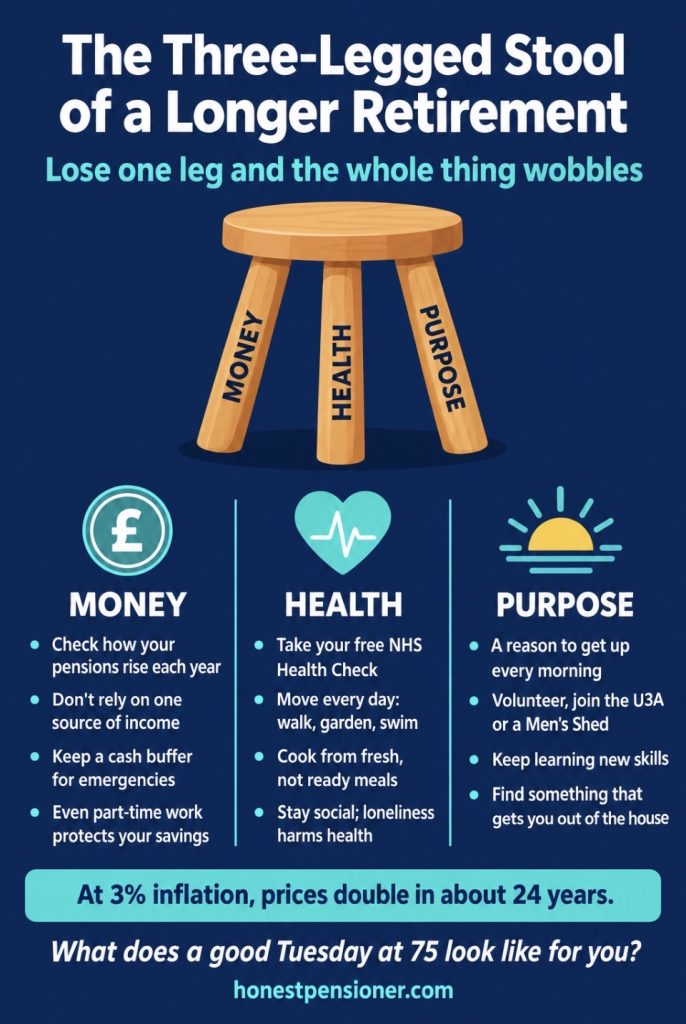
Table of Contents
Why a Longer Retirement Changes the Maths
Many years ago I was talking to my uncle about his retirement. He told me something I’ve never forgotten.
He had been retired for longer than he had worked.
That sounds like a happy problem. For him it wasn’t. His pension had been steadily eaten away by inflation, and he told me plainly that he wished he had kept working for longer.
Here’s why that happens. At 3% inflation, prices roughly double in about 24 years. A fixed income that felt comfortable at 65 buys only half as much by your late 80s.
Think about it this way. Your grandfather bought his house for £4,000. Your father paid £40,000 for his. You paid £400,000 for yours. What will today’s toddler pay?
Some of that rise is houses becoming harder to afford, but much of it is simply money being worth less. The same thing happens, quietly, to every pound in your pension.
Most people plan for a retirement of 15 or 20 years. A longer retirement of 30 years needs a very different plan, and it needs all three legs of the stool.
Leg One: Money for a Longer Retirement
Money gives you choices about how you can afford to live. The aim isn’t wealth for its own sake. It’s having enough to keep doing the things that matter.
1. Check how your pension income rises
The State Pension is currently protected by the triple lock. It rises each April by the highest of inflation, earnings growth or 2.5%.
That protection won’t last forever. Prime Minister Andy Burnham has announced that, if Labour wins the next election, the triple lock will be replaced from April 2030. The State Pension would then rise by the higher of inflation or 2.5%.
Many workplace and private pensions are less generous still. Some rise by a capped amount, and some don’t rise at all. A level annuity pays more at the start but loses ground every single year. Check your paperwork and find out exactly how each of your pensions increases.
2. Don’t rely on a single source of income
The rules our parents retired under were fairly predictable. Ours are not. Government debt is now close to the size of the whole economy, which squeezes what any government can promise pensioners.
The answer is resilience. Spread your income across the State Pension, any workplace pensions, savings and, if you can, a little earned income. Keep an emergency cash buffer, and keep some money invested so it has a chance to outpace inflation.
3. Consider working a little longer
Even part-time work makes a real difference. Every year you earn something is a year you aren’t drawing down your savings. That was my uncle’s lesson, and it’s one worth taking seriously.
Leg Two: Health
Health gives you choices about what you’re physically able to do. All the money in the world won’t help much if you can’t get out to enjoy it.
4. Invest in your health before you need to
We tend to think about our health only when something goes wrong. The better approach is to treat it like a pension: small, regular contributions that add up over decades.
- Take up your free NHS Health Check. If you’re aged 40 to 74 in England, you’re invited every five years. It can spot early warning signs of heart disease, stroke and diabetes.
- Keep moving every day. Walking, gardening, swimming or simply being on your feet all count.
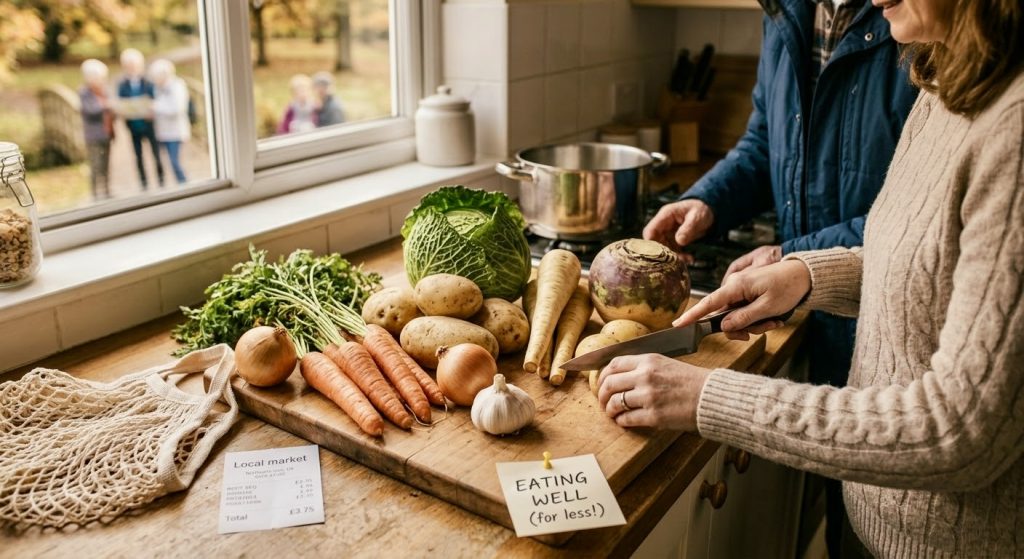
- Eat well on a budget. Good food doesn’t have to be expensive, even on a pension. Eating well means cooking from fresh rather than relying on ready meals and processed food. Fresh vegetables are often cheaper than people think; they just take a little longer to prepare. In retirement, that time is something many of us have more of, and cooking from scratch can become a pleasure in itself.
- Stay social. Loneliness is linked to poorer physical and mental health, which brings us neatly to the third leg.
Leg Three: Purpose
Everyone in retirement needs a reason and a purpose to get up in the morning.
Purpose is the leg people most often forget. Yet it’s the one that gives you a reason to make the most of the other two legs of the stool.
5. Find a reason to get out of the house
My wife and I deliver parcels. We don’t really do it for the money. It’s cheaper than a gym membership, and we get paid to stay healthy! It also gives us the mental stimulation of chatting to the people on our round, and over time we’ve got to know many of them. And the money we earn goes on great holidays.
That one activity covers all three legs of the stool. It keeps us moving, it keeps us connected and it brings in a little extra income.
You don’t need a fortune to stay busy in retirement. Plenty of options cost little or nothing:
- Volunteering with a local charity, hospital or community group
- Joining the U3A, which offers hundreds of low-cost interest groups
- Walking groups, community gardens or allotments
- Men’s Sheds, which bring people together over practical projects
- Part-time local work, especially jobs that involve meeting people
6. Keep learning and building
I started Honest Pensioner from scratch, running it on my own. Learning new skills, writing and solving problems keeps my mind sharp in a way that sitting still never would.
With AI tools making it easier than ever to start something small, retirement can be a time to build, not just wind down.
When One Leg Starts to Wobble
In a longer retirement, at least one leg is likely to wobble at some point. Health can change suddenly. Money can run tighter than expected. A partner may need care.
7. Protect the stool before it tips
The time to prepare is while all three legs are still strong.
- Set up Lasting Powers of Attorney for both property and financial affairs and health and welfare.
- Know what help exists. Attendance Allowance isn’t means-tested, yet many people who qualify never claim it.
- Understand care costs and how they could affect your home and savings.
- Review your plan every year or two. Pension, tax and benefit rules will keep changing, so a plan made at 65 needs checking.
- Watch for scams. People looking for extra retirement income are a prime target for fraudsters.
Picture Your Tuesday at 75
Here’s a simple exercise. Take ten minutes with a cup of tea and a notepad, and imagine an ordinary Tuesday when you’re 75.
- Where do you wake up, and who’s with you?
- What gets you out of the house that day?
- Who do you speak to?
- What are you physically able to do?
- What does that day cost, and where does the money come from?
If any answer makes you uneasy, that’s the leg to work on now.
Final Thoughts
A longer retirement is a gift, but only if those extra years are good ones. Money, health and purpose are the three legs that hold everything up.
You don’t need a fortune to keep all three strong. You need to think about planning for retirement as a whole, find a reason to get out of the house, and be willing to start today rather than when something goes wrong.
What gets you out of bed in retirement? Let me know in the comments.
Your Longer Retirement Checklist
💷 Money
□ Check your State Pension forecast.
□ Find out how each of your pensions rises every year
□ List every income source: State, workplace and personal pensions, and savings
□ Make sure your budget allows for rising costs over 25+ years
❤️ Health
□ Book your free NHS Health Check if you’re 40–74
□ Move every day: walk, garden or stretch
□ Cook from fresh more often
□ Book a dental and eye check this year
☀️ Purpose
□ Have at least one thing that gets you out of the house each week
□ Try the U3A, a Men’s Shed, volunteering or a class
□ Learn one new skill this year
□ Stay in regular touch with friends and family
🛡️ Safeguards
□ Set up Lasting Powers of Attorney
□ Check whether you’re entitled to Attendance Allowance or Pension Credit
□ Review your longer retirement plan once a year
□ Remember: your bank will never ask for your PIN or to move money
Frequently Asked Questions
How long should I plan for my retirement to last?
It’s sensible to plan for at least 30 years. Many people now spend as long retired as they did working, so a longer retirement needs to be part of your plan from the start.
Is the State Pension triple lock ending?
The triple lock remains in place for the rest of this Parliament. Prime Minister Andy Burnham has announced that, if Labour wins the next election, it will be replaced from April 2030 by a rise of inflation or 2.5%, whichever is higher.
How does inflation affect my pension?
Inflation reduces what your money can buy. At 3% a year, prices roughly double in about 24 years, so a pension that doesn’t rise with inflation loses half its value over a longer retirement.
How can I stay active and social in retirement on a budget?
Try volunteering, the U3A, walking groups, Men’s Sheds, community gardens or part-time local work. Most cost little or nothing and give you a reason to get out of the house.
Should I keep working after State Pension age?
It’s worth considering. Even part-time work reduces how much you draw from savings, keeps you active and gives you a sense of purpose. You also stop paying National Insurance once you reach State Pension age.


It was good to read an article that was both sensible and informative
Loved the story too
And the 3 Legged Stool has always been our reference point for retirement as it relates to money 💵
Health is indeed important as is purpose but we do need money to have the little extras in life and for some even the basics
It’s why Chris and I looked to the internet in 2010 to rescue our retirement in the first instance and laterly for choices as we enter our 70’sxand beyond
Thanks so much, Susan, I really appreciate you taking the time to comment.
You’ve put your finger on it. Health and purpose make retirement worth living, but money is what lets you enjoy the little extras, and for many people it decides whether they can cover the basics at all. That’s why the stool needs all three legs.
Hats off to you and Chris for taking matters into your own hands back in 2010. Rescuing a retirement and then building real choices into your 70s is exactly the sort of story our readers need to hear. I’m glad the story in the article struck a chord too.
Best wishes to you both,
Mark