

NHS Continuing Healthcare is one of the most valuable forms of help an older person can get, and one of the least understood. If you qualify, the NHS pays the full cost of your care, including care home fees. There is no means test and no need to sell the house.
Before I started Honest Pensioner, I spent around 15 years as a mortgage and finance adviser, talking families through wills, powers of attorney and the cost of care. Few had heard of this funding, even when a parent’s needs were clearly medical.
This guide covers England. Wales has similar rules; Scotland and Northern Ireland work differently.
Table of Contents
What Is CHC Funding?
So what is NHS Continuing Healthcare funding? It’s a package of care arranged and paid for entirely by the NHS for adults with ongoing, complex health needs. You can receive it at home, in a care home or in a hospice.
The key point is that it is not means tested. Your savings, pension and home are not part of the decision. Compare that with council-funded care, where people with savings above the upper limit pay the whole bill (see our guide to care home fees).
Your local Integrated Care Board (ICB) decides who qualifies, using the rules in the National Framework for NHS Continuing Healthcare and NHS funded nursing care. The government also publishes a short public information leaflet worth reading first.
Who Qualifies? The Primary Health Need Test
NHS Continuing Healthcare eligibility does not depend on a diagnosis. Dementia, Parkinson’s or a stroke do not qualify on their own. What matters is whether your care needs are mainly health needs rather than social care needs. This is called a primary health need.
Approval rates vary hugely: Age UK found about 5% of people approved in some areas and 58% in others.
6 Signs You May Be Eligible for CHC
- Needs that change hour to hour. Sudden falls, seizures or blackouts that staff can’t predict and must react to quickly.
- Challenging behaviour. Aggression, severe agitation or wandering linked to dementia or mental illness that puts the person or others at risk.
- Breathing difficulties. Needing oxygen, suction or a ventilator, or frequent episodes of breathlessness.
- Complex medication. A syringe driver, regular changes to pain relief, or medicines that need close monitoring by a nurse.
- Several serious needs at once. For example tube feeding, pressure sores and being unable to move without a hoist.
- A rapidly deteriorating condition. Someone nearing the end of life may qualify quickly through the Fast Track route.
One trap to watch for: if good care is keeping a problem under control, it still counts. The framework calls this a well-managed need. Don’t accept that a condition ‘isn’t an issue’ just because the care home handles it well.
How the NHS Continuing Healthcare Assessment Works
Step 1: The CHC Checklist
The CHC checklist is a short screening form, usually completed by a nurse, doctor or social worker. It scores 11 areas of need as A, B or C. A positive checklist leads to a full assessment, not automatic funding. You can read the official checklist guidance on GOV.UK.
Step 2: The Decision Support Tool (DST)
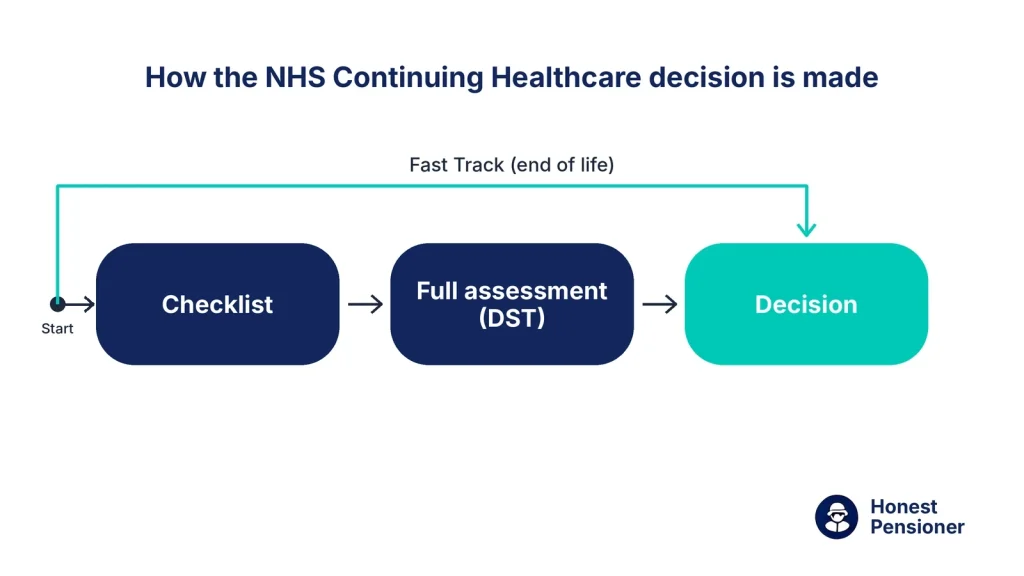
Next comes a full assessment by at least two professionals, recorded on the decision support tool (DST). It covers 12 areas, including breathing, nutrition, mobility, cognition and behaviour. Each is rated from no needs up to severe or priority. A priority rating in one area, or severe in two, usually means you qualify.
The ICB should normally reach a decision within 28 days of receiving the checklist.
The Fast Track Pathway
If someone’s condition is getting worse quickly and they may be entering the final stage of life, a clinician can complete a Fast Track form. No checklist or DST is needed. Care should be arranged within days, so the person can be looked after at home, in a hospice or in a care home.
What Does CHC Funding Cover?
In a care home, NHS Continuing Healthcare (CHC) funding pays the full fees, including your room and meals. At home, it pays for your care and support, but not your rent, mortgage, food or household bills.
At home you can ask for a personal health budget. This gives you more say over who cares for you and when.
Is CHC permanent? No. Continuing healthcare funding is reviewed after three months, then yearly.
In a care home, Attendance Allowance stops after 28 days of CHC funding. At home, it carries on. Our Attendance Allowance guide explains more.
Turned Down? Check for NHS-Funded Nursing Care
The difference between NHS Continuing Healthcare and NHS-funded nursing care matters. If you’re turned down but live in a nursing home and need care from a registered nurse, you should get NHS-funded nursing care (FNC) instead. The NHS pays this directly to the home. From April 2026, the standard rate is £267.68 a week.
How to Challenge a “No”
Decisions on eligibility for NHS Continuing Healthcare can be overturned. The appeal route is:
- Ask the ICB for a local review, in writing, within six months of the decision letter.
- If you’re still unhappy, ask for an independent review panel through NHS England.
- As a last resort, complain to the Parliamentary and Health Service Ombudsman.
Ask for copies of the checklist and DST and check them against medical records. If you or a relative paid for care in the past without being assessed, ask the ICB to review a ‘previously unassessed period of care’. Time limits can apply, so act promptly.
For free help, Beacon offers up to 90 minutes of free advice funded by NHS England (0345 548 0300). Age UK’s Factsheet 20 is also excellent. If you’re acting for a parent, having a lasting power of attorney in place makes the whole process far easier.
Frequently Asked Questions
What is not covered by the NHS?
Most social care, such as help with washing and dressing, is means tested by your council. Living costs at home are not covered, even on CHC.
What is an NHS care package?
It’s the care agreed to meet your assessed needs, such as carers at home or a nursing home place. With NHS Continuing Healthcare, the NHS pays for the whole package.
Whatever the outcome, having your affairs written down helps your family act quickly when care decisions arrive. Our UK Life Organiser keeps your key details, contacts and wishes in one place.